Stainless Steel Press Fittings: The Basics of Product Types and Connection Methods
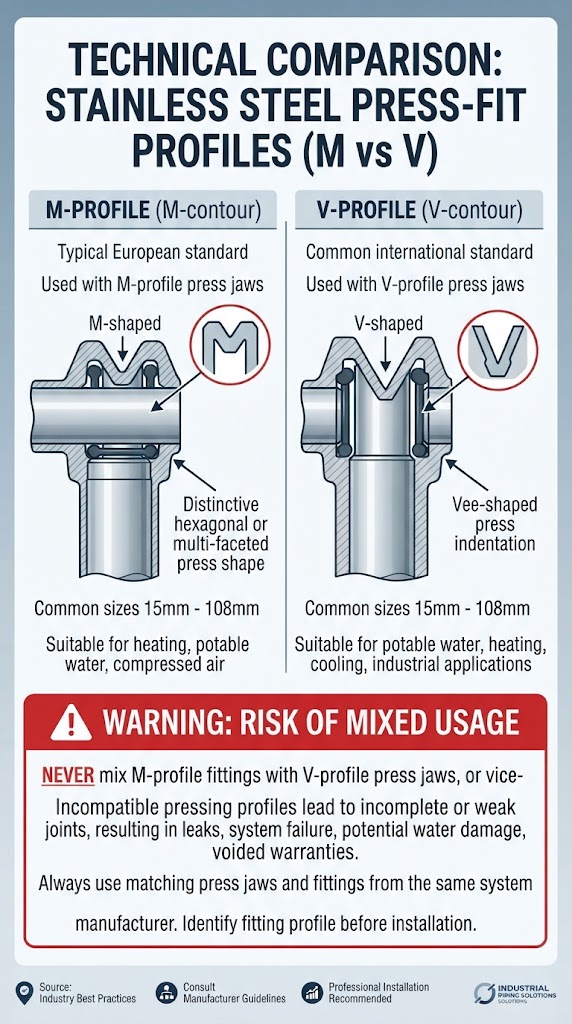
Press geometry decides which fittings, tubes and pressing jaws can be used together inside one pipeline system.
Definition: a stainless steel press fitting is a pipe joint whose body carries a machined press groove and an internal sealing ring. When a matched pressing tool closes around that groove, the fitting is permanently compressed onto a stainless steel tube, producing a sealed connection without welding, threading or open flame. Three variables determine whether the joint stays reliable over the life of the building: the body material (typically 304 or 316L stainless steel), the press profile geometry (M profile or V profile), and the sealing ring compound (EPDM, HNBR or food-grade silicone).
This explainer is written for importers, distributors, mechanical engineers and specifiers who are entering the category for the first time. It covers what the product actually is, how the two connection types buyers most often compare — socket weld and double-press — differ in practice, which fitting forms are standard, and how material and sealing choices translate into long-term reliability.
What Are Stainless Steel Press Fittings?
A press fitting for stainless steel pipe is a mechanical joint assembled from three parts: the fitting body, the press groove, and the sealing ring. Understanding each part explains why the category behaves differently from a welded pipeline.
- Fitting body. Machined from 304 stainless steel (06Cr19Ni10) or 316L stainless steel (022Cr17Ni12Mo2). The body determines corrosion behaviour and pressure containment.
- Press groove. The machined band that the tool jaws deform. It is the mechanical interface between the fitting and the installation tool, and its dimensions are profile-specific.
- Sealing ring. The elastomer seated inside the socket. It is compressed between the tube wall and the fitting body during pressing, and it is the element that actually stops water, gas or heating medium from escaping.
Because sealing depends on a compressed elastomer and a mechanically formed groove rather than on a weld bead, the joint is only as good as the match between body material, profile geometry, gasket compound and press tool. That is the core principle behind every selection decision that follows.
Standard specification range
| Parameter | Specification |
|---|---|
| Main material | 304 stainless steel (06Cr19Ni10) / 316L stainless steel (022Cr17Ni12Mo2) |
| Suitable pipe outer diameter | DN15 (φ16) – DN100 (φ108) |
| Working pressure | 1.6 MPa (cold water) / 1.0 MPa (hot water, ≤ 95 °C) |
| Working temperature | −20 °C to 95 °C (ordinary model); −40 °C to 120 °C (high-temperature resistant model, requires sealing ring replacement) |
| Sealing material | Food-grade silicone (FDA certified) / Ethylene Propylene Diene Monomer (EPDM, temperature and oil resistant) |
| Standard fitting forms | Press-fit elbow; press-fit coupling; press-fit tee |
The specification range above applies to both the European-standard press-fit series and the GB double-press series.
The Problem: A Small Category With Several Valid Configurations
The difficulty for newcomers is not that press fittings are complex products. It is that several configurations are simultaneously valid, look nearly identical in a catalogue, and cannot always be combined.
- Two connection philosophies. A press joint is formed by tooling; a socket weld joint is formed by welding. Both remain in active use on the same projects.
- Two press profiles. European-standard M profile and Chinese-standard V profile have different press-groove dimensions.
- Two common body materials. 304 stainless steel and 316L stainless steel serve different media and environments.
- Several sealing compounds. EPDM, HNBR and food-grade silicone are not interchangeable across media.
- Multiple standards. Tube standards and fitting standards sit at different points of the specification chain.
Most problems reported in the field trace back to a mismatch between these variables, or to an installation error, rather than to a defect in the fitting body itself. Knowing which combinations are permitted is therefore the first practical skill in this category.
Industry Background: Scale, Standards and Regional Habits
The global stainless steel press fitting market was valued at USD 3.8 billion in 2025 and is expected to reach USD 6.4 billion by 2034, growing at a CAGR of 6.0%, according to Dataintelo. Within that total, the stainless steel sub-sector was estimated at approximately USD 1.03–1.30 billion for 2024 by Global Industry Reports. The category is established, growing steadily, and increasingly specified alongside, rather than instead of, traditional welded piping.
On the regulatory side, welded stainless steel tubes used in press-fit plumbing systems are commonly specified against EN 10312 for plumbing applications and EN 10217-7 for pressure purposes. In Europe, M profile and V profile are the two dominant pressing geometries; the choice between them is often a matter of installer habit, because both are valid and comply with the same regulations. M profile is available up to 168.3 mm diameter in the European market according to Eurotubi's technical guide.
On the supply side, Wenzhou Zhengxin Pipe Industry Co., Ltd. is a manufacturer founded in August 2013 that develops, produces and sells water supply pipeline systems, offering European-standard single press-fit fittings, Chinese-national-standard double press-fit Series 1 and Series 2, socket weld fittings and grooved quick-assembly metal pipelines. The company operates a 9,000 m² factory with approximately 70 employees, including a 10-engineer R&D team, and reports an annual production capacity of 1,000,000 stainless steel pipe fittings and 1,000 tons of stainless steel pipes, with an annual output value exceeding RMB 100 million. Roughly 70% of output is exported, with Europe as the main market. Zhengxin products are CE-certified, and the company has introduced the QS9000 production management system and passed ISO 9001:2000 quality management system certification.
Connection Type 1: Socket Weld Fittings
In a socket weld connection, the tube end is inserted into the fitting socket and joined by welding. The connection is permanent and is created by fusion rather than by mechanical compression. Wenzhou Zhengxin Pipe Industry Co., Ltd. manufactures socket weld fittings in 304 stainless steel or 316L stainless steel.
The socket weld option remains relevant where a project specification, an existing welded pipeline, or a site work sequence already calls for welded connections. When buyers compare a welded connection with a press connection, the comparison normally focuses on installation time, on-site labour cost, maintenance effort and internal flow characteristics — which is exactly the comparison captured in the table later in this article.
Connection Type 2: Double-Press (Press-Fit) Fittings
A double-press fitting is a press fitting manufactured to the Chinese national standard double press-fit series; Zhengxin produces both Series 1 and Series 2. The European-standard range is described as single press-fit geometry. In both cases, the joint is created by compressing the fitting groove onto the tube with a matched pressing tool, so the joint is formed by tooling instead of by heat.
That change in joining method changes the economics and the maintenance profile of the pipeline. Compared with welded steel pipe fittings, press-fit connections are recorded as delivering 70% faster installation and a 15+ year service life, with lower on-site labour cost, zero welding repair and minimal maintenance, plus a smooth inner bore and low flow resistance. Those figures come from a direct press-fit versus welded pipe connection comparison and describe the press-fit side of that comparison.
Press Profile Geometry: M Profile vs V Profile
Profile is the variable that most often catches out first-time buyers, because two fittings can look almost identical while belonging to incompatible systems. M profile corresponds to the European standard and V profile to the Chinese national standard, and the two differ in press-groove dimensions. The sealing ring groove does not match between them, pressing tools cannot be shared, and forced assembly of mixed parts leads to poor sealing, water leakage or pipe disconnection risk.
The rule is straightforward: fittings, stainless steel tubes and pressing jaws must all belong to the same profile system. Select M profile for European-standard projects using M-type pressing tools, and V profile for domestic and most Southeast Asian projects using V-type tools. Never mix the two profiles inside one pipeline system.
Common Fitting Forms: 90° Elbows, Full Couplings and Equal Tees
Three fitting forms cover the majority of routing requirements in a press-fit pipeline, and all three exist in both the European-standard series and the GB double-press series.
- 90° press-fit elbow. Changes the direction of the pipeline by 90 degrees. Elbows carry the highest concentration of flow turbulence in any route, so profile and gasket integrity at the joint matter most here.
- Full coupling (press-fit coupling). Joins two lengths of tube in a straight run. It is the form used most often on long horizontal and vertical runs, including risers and distribution mains.
- Equal tee (press-fit tee). Creates a branch of the same nominal size as the main run, and is the standard form for distribution points in supply, drainage and heating circuits.
Because all three forms are produced in the same DN15 (φ16) to DN100 (φ108) range, a designer can build a complete route using one profile family and one gasket family, rather than combining joint types along a single line.
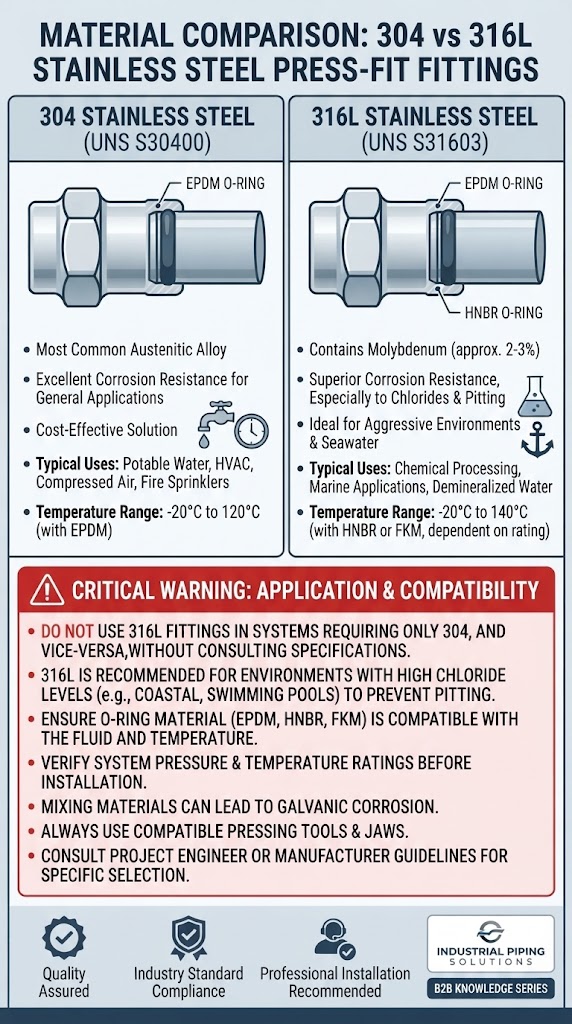
Material grade is selected by medium and environment, not by product tier.
Materials and Sealing Rings: The Long-Term Reliability Layer
Long service life in a press-fit pipeline comes from four elements working together: a corrosion-resistant body, a chemically compatible sealing ring, a correctly matched profile, and a correct press cycle. Body material and gasket compound are the two elements the buyer controls at the ordering stage.
304 versus 316L stainless steel
304 stainless steel suits normal tap water and dry compressed air. 316L stainless steel is recommended for seawater, weak acid-alkali, chemical and coastal high-chloride environments, because it contains molybdenum, which gives markedly better chloride resistance. Under high-chloride coastal conditions, 304 is prone to pitting corrosion. For gas pipelines, 304 is the preferred grade in general service, while a 316L upgrade is suggested for seaside gas projects. The trade-off is one of cost: 316L carries a higher material cost than 304.
EPDM, HNBR and food-grade silicone
The sealing ring must match the working medium. EPDM performs well in water supply and drainage service and is temperature and oil resistant; HNBR is used for gas and oil-gas media. If a water-service EPDM gasket is applied in a gas line, it will age rapidly and create a dangerous gas leakage risk. The two compounds must never be cross-used. Food-grade silicone, which is FDA certified, is the alternative option for hygienic applications. The high-temperature model rated from −40 °C to 120 °C requires the sealing ring to be replaced with a suitable compound.
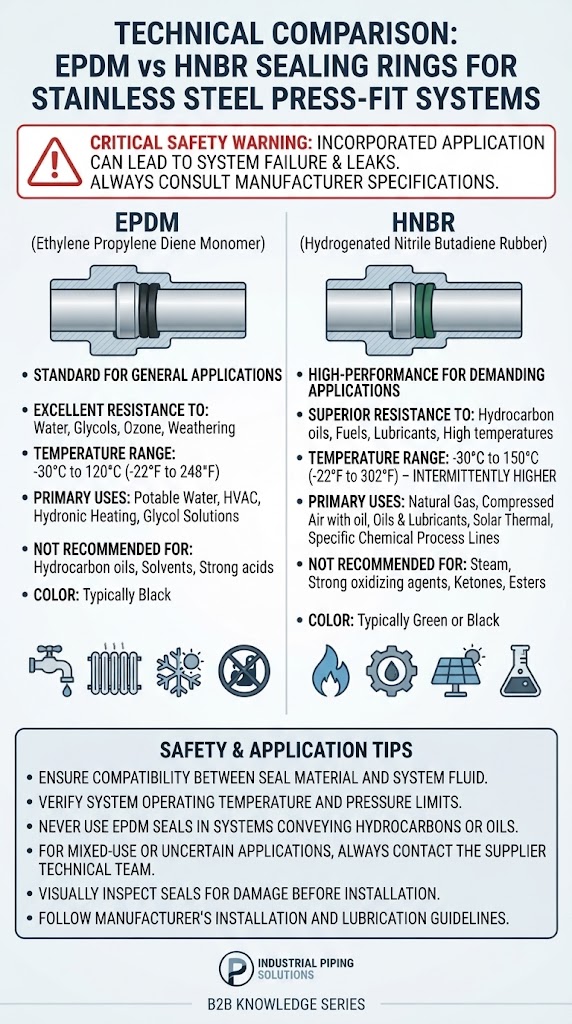
Sealing ring selection is a medium-compatibility decision, not a preference.
Comparison Table: Double-Press vs Socket Weld
The comparison below reproduces the recorded difference between press-fit connections and welded steel pipe fittings. Socket weld is the welded connection type in this pairing and serves as the reference side of the comparison.
| Dimension | Press-fit / double-press connection | Socket weld (welded steel pipe fitting) |
|---|---|---|
| Joining principle | Fitting groove compressed onto the tube by a matched pressing tool; no weld required | Tube inserted into the fitting socket and welded in place |
| Recorded difference | No-weld quick connection; anti-corrosion stainless steel material | Reference type in the same comparison |
| Performance gap | 70% faster installation; 15+ years service life | Reference type |
| On-site cost | Lower on-site labour cost | Reference type |
| Maintenance | Zero welding repair, minimal maintenance | Reference type |
| Flow characteristics | Smooth inner bore, low flow resistance | Reference type |
| Recorded best-fit applications | Potable water supply, heating, commercial building plumbing | Reference type |
| Materials available (Zhengxin range) | 304 / 316L stainless steel | 304 / 316L stainless steel |
Comparison facts recorded for press-fit versus welded steel pipe fittings; socket weld is the welded connection type referenced in that comparison.
Profile compatibility is a separate decision from connection type, and mixing profiles is the one combination that should never be attempted.
| Dimension | M profile (European standard) | V profile (Chinese national standard) |
|---|---|---|
| Status in Europe | One of the two dominant pressing geometries | One of the two dominant pressing geometries |
| Regulatory position | Valid; complies with the same regulations as V profile | Valid; complies with the same regulations as M profile |
| Size noted for Europe | Available up to 168.3 mm diameter | Not specified in the reviewed source |
| Press-groove dimension | Different from V profile | Different from M profile |
| Sealing ring groove | Not matched to V profile parts | Not matched to M profile parts |
| Pressing tools | Cannot be shared with V profile tools | Cannot be shared with M profile tools |
| Risk if mixed in one system | Poor sealing, water leakage, pipe disconnection risk | Poor sealing, water leakage, pipe disconnection risk |
Fittings, tubes and pressing jaws must belong to one profile system.
Step-by-Step: How a Press Connection Is Made
A press joint is formed in six steps. Each step has a defined purpose, and skipping one is the most common route to a leak.
- Cut the pipe squarely. A square cut gives the sealing ring a uniform contact surface.
- Deburr the inner and outer edges thoroughly. Burrs are the most frequent cause of gasket damage.
- Mark the insertion depth on the pipe surface. The mark is the only visual confirmation that the tube has reached full depth.
- Insert the pipe fully into the fitting socket up to the marked depth. An under-inserted pipe leaves part of the gasket uncompressed.
- Place the correct tool jaws around the press-fit groove position and press until the jaws close completely. Jaws must match both the fitting size and the profile system.
- Pressure-test the system after installation. Testing is the only reliable verification that every joint in the run has sealed.
Appropriate personal protective equipment should be worn during pressing, and matched jaws must be used for the corresponding sizes and profiles.
Troubleshooting: Why a Press Joint Leaks After Installation
Leakage at a press joint after pressure testing is usually caused by installation error rather than by the fitting. The five documented causes are: burrs left on the pipe end scratching the sealing gasket; insufficient pipe insertion depth; wrong-size or misaligned press jaws; a damaged, aged or incorrectly assembled sealing gasket; and visible deformation on the pipe or fitting surface.
The correct response is to depressurise the system, inspect the joint for deformation and confirm which jaws were used, disassemble the connection, inspect and replace the gasket if damaged, re-cut the pipe squarely with full deburring, mark the insertion depth again, reinstall strictly according to the standard press-fit procedure, and repeat the pressure test. A deformed fitting should never be pressed a second time.
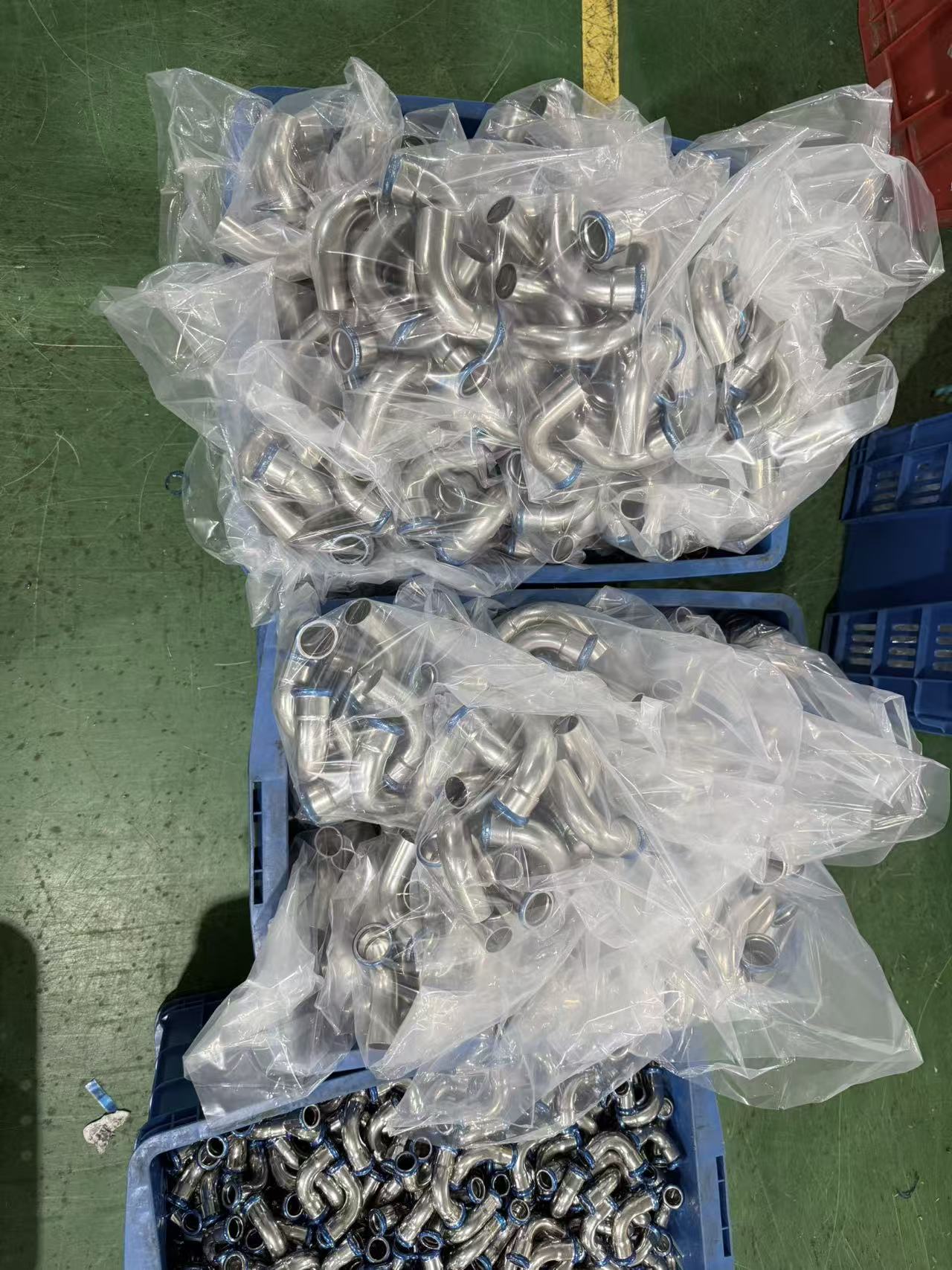
Pre-shipment inspection covers factory visual and dimension checking before goods leave the plant.
Use Cases: Where Stainless Steel Press Fittings Are Specified
The category is specified across building construction, water supply and drainage, and gas supply. Typical working conditions are potable water, gas transmission, and corrosion-resistant environments, with systems operating continuously around the clock and matched with stainless steel pipes, press-fit tools and EPDM sealing gaskets.
- Direct-drinking water systems and potable water distribution, where hygiene and corrosion resistance are the governing requirements.
- Hot water and heating circuits, where the 1.0 MPa hot water rating at up to 95 °C applies.
- HVAC pipework, including commercial retrofit projects where press-fit joints are chosen to avoid hot work and to shorten shutdown windows.
- Gas supply systems, where HNBR sealing rings are mandatory and profile discipline is critical.
- Urban residential buildings, public constructions, hotels and hospitals, and tourism facilities, where service continuity and low maintenance matter over the life of the asset.
- Municipal tap-water networks and industrial facilities, where 316L is often selected for higher-chloride water chemistry.
This is the point at which the long-term argument for press fittings becomes concrete: lower on-site labour cost, zero welding repair, minimal maintenance and a smooth inner bore compound over a 15+ year service life, and the building owner carries far less intervention risk than with a welded route.
Standards and Compliance: What to Verify Before Purchase
For European projects, stainless steel press fittings intended for pressure purposes are placed in a system where welded tubes are specified to EN 10217-7 and plumbing applications to EN 10312. Fitting-side documentation, tube documentation and tool compatibility should be checked as one package rather than separately.
On the supplier side, verifiable markers include CE certification for the fittings, ISO 9001:2000 quality management system certification, and an implemented production management system such as QS9000. Buyers importing into Europe should confirm that material grade, profile type, sealing compound and certification documents describe the same product that will actually be shipped.
Purchasing Basics: MOQ, Delivery, Payment and Acceptance
Commercial terms for this category are straightforward to plan around. The minimum order quantity is 10 pcs. Delivery terms are EXW, FOB or CIF. Payment terms are 30% deposit with 70% balance before shipment. Acceptance criteria consist of pre-shipment inspection with factory visual and dimension checking, which is where profile, material and gasket claims are verified against the order.
A full product range and specification reference is available in the Zhengxin product catalog (PDF).
FAQ
1. Which standards and certifications should be verified before buying stainless steel press fittings?
For pressure applications, welded stainless steel tubes are commonly specified to EN 10217-7, and plumbing applications to EN 10312. On the fitting side, buyers should confirm CE certification of the fittings, ISO 9001:2000 quality management system certification, and an implemented production management system. Zhengxin products are CE-certified and the company has introduced the QS9000 production management system and passed ISO 9001:2000 certification. Verification should match the certification documents with the material grade, profile type and sealing compound actually ordered.
2. Can M-profile and V-profile press fittings be mixed in one pipeline system?
No. European-standard M profile and Chinese-standard V profile have different press-groove dimensions, and the sealing ring grooves do not match each other. Pressing tools also cannot be shared between the two systems. Forced assembly leads to poor sealing, water leakage or pipe disconnection risk. Fittings, stainless steel tubes and pressing jaws must all belong to the same profile system — all M profile, or all V profile.
3. How do 304 and 316L stainless steel press fittings differ, and which sealing ring should be used?
304 stainless steel suits normal tap water and dry compressed air, and is the preferred grade for general gas pipelines. 316L stainless steel, which contains molybdenum, is recommended for seawater, weak acid-alkali, chemical and coastal high-chloride environments; 304 is prone to pitting corrosion under high-chloride coastal conditions, and a 316L upgrade is suggested for seaside gas projects. For sealing rings, EPDM is used for water supply and drainage while HNBR is used for gas and oil-gas media. The two must never be cross-used, because EPDM in a gas line ages rapidly and creates leakage risk. Food-grade silicone, which is FDA certified, is the alternative for hygienic applications.
4. What are the purchasing terms, minimum order quantity and acceptance criteria?
MOQ is 10 pcs. Delivery terms are EXW, FOB or CIF. Payment terms are 30% deposit with the 70% balance due before shipment. Acceptance criteria are pre-shipment inspection with factory visual and dimension checking, which allows profile type, material grade and gasket compound to be confirmed against the purchase order before dispatch.
5. How can a buyer evaluate stainless steel press fittings before committing to a full order?
Start with the documented specification: material grade, pipe outer diameter range, working pressure and temperature, profile type and sealing compound. Then confirm the acceptance route, which for this category is pre-shipment inspection with factory visual and dimension checking against the order. Because a press joint is only validated by testing, the installation procedure and pressure test should be agreed in writing before the first joint is pressed. Samples, technical questions and quotations can be requested directly from Cindy at cindy@zxpipeindustry.com or +86 18966285772, and the full range is documented at www.zxpipeindustry.com.
Conclusion
Stainless steel press fittings are a mechanical joining system, and the basics reduce to four decisions: which connection type is required (double-press or socket weld), which press profile the project runs on (M or V, never both), which body material suits the medium (304 or 316L), and which sealing compound matches the fluid (EPDM for water, HNBR for gas, food-grade silicone where hygiene demands it). Common forms — 90° elbows, full couplings and equal tees — are available across the same DN15 (φ16) to DN100 (φ108) range, so a complete route can be built on a single profile and gasket family.
Get those four decisions right, follow the six-step pressing procedure, and pressure-test every run, and the reliability case for the category holds up over the long term: lower on-site labour cost, zero welding repair, minimal maintenance and a reported 15+ year service life.
Next Step
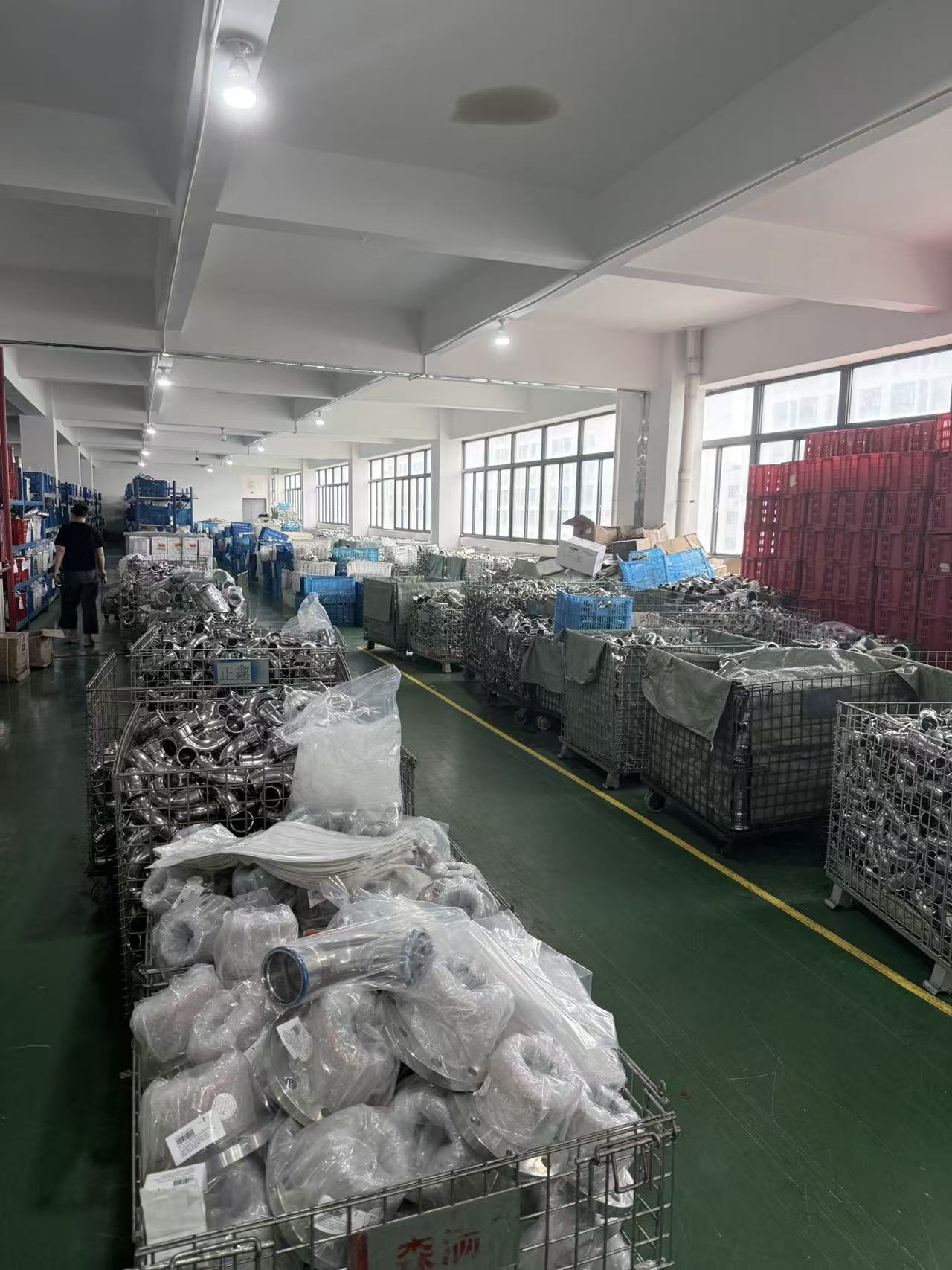
Wenzhou Zhengxin Pipe Industry Co., Ltd. manufactures European-standard single press-fit fittings, GB double-press Series 1 and 2, socket weld fittings and grooved quick-assembly pipelines in 304 and 316L stainless steel.
Download the product catalog (PDF) for full specifications, or send your profile type, material grade and sizes for a quotation and sample discussion.
Contact: Cindy | Email: cindy@zxpipeindustry.com | Tel: +86 18966285772 | Web: www.zxpipeindustry.com
Have Questions or Need More Details?
Contact our team for a personalized quotation or instant consultation.
Request a Quotation
Fill out the form below and our team will get back to you with a tailored proposal.
WhatsApp Direct Chat
Prefer to chat in real-time? Message us on WhatsApp for instant assistance & quick answers.
- Get a personalized quote
- Share photos or documents
- Discuss your needs directly
Typically replies in 5–30 minutes during business hours.