Application Guide: Selecting Press Fittings for Urban Residential Building Projects
Specifying stainless steel press fittings for an urban residential building is a decision made once and lived with for decades. Once the pipework disappears into riser shafts, ceiling voids and wall chases, the only variables that still matter are the ones fixed at the drawing stage: material grade, diameter coverage, sealing material, and how the joint is actually made on site.
This application guide walks through that decision for new residential developments. It explains how to match product specifications — 304 stainless steel (06Cr19Ni10) or 316L stainless steel (022Cr17Ni12Mo2), pipe outer diameters from DN15 (φ16) to DN100 (φ108), and EPDM or food-grade silicone sealing rings — to the real conditions of a domestic water supply system, using GB Double-press Fittings from WENZHOU ZHENGXIN PIPE FITTINGS CO., LTD as the worked example.
The Specification Problem: What a Residential Domestic Water System Actually Demands
A residential decision differs from an industrial retrofit decision because the pipework is installed once, concealed, and expected to run continuously. The published application data for this scenario describes systems operating 24/7 under potable water, gas transmission and corrosion-resistant conditions, with special requirements covering leak-proof performance, corrosion resistance and potable-water hygiene.
In practice, four failure modes cause most problems after handover, and all four are specification or workmanship issues rather than product defects:
- Gasket damage from pipe burrs — inner or outer burrs left on the pipe end scratch the sealing gasket during insertion.
- Insufficient insertion depth — the pipe is not pushed fully into the fitting socket up to the depth mark.
- Mismatched or misaligned pressing jaws — wrong jaw size, wrong profile or incorrect jaw position on the fitting groove.
- Wrong sealing ring for the duty — a gasket that is damaged, aged, or simply not suited to the media and temperature of the line.
Because concealed residential pipework is expensive to reopen, the practical goal of fitting selection is to remove these variables before procurement: fix the grade, fix the diameter coverage, fix the sealing material, and confirm that the pressing tooling on site matches the fitting being delivered.
The variables that must be closed out at specification stage are therefore:
- Material grade — 304 or 316L
- Diameter coverage against the full drawing set
- Sealing material and temperature capability
- Working pressure and working temperature envelope
- Joining principle and tool profile compatibility
- Quality documentation and supply capacity
Industry Background: Why Press-Fit Became the Default for Residential Risers
The stainless steel press fitting market is valued at USD 3.8 billion in 2025, and Dataintelo projects it to reach USD 6.4 billion by 2034, a CAGR of 6.0%. Within that total, the stainless steel sub-sector specifically was estimated at approximately USD 1.03–1.30 billion for 2024 by Global Industry Reports, equivalent to roughly 29%–38% of the overall press fitting market.
Two regulatory reference points shape European residential specifications. Stainless steel press systems for pressure purposes are commonly specified against EN 10312 for plumbing, with welded stainless tubes referenced to EN 10217-7; technical documentation from European tube producers also cites DVGW W541 compliance for potable water service.
Profile geometry is the second specification point that catches buyers out. M Profile and V Profile are the two dominant pressing geometries in Europe, with M Profile available up to 6" (168.3 mm) diameter. European technical guidance notes that both profiles are valid and comply with the same regulations, and that the choice between them is often a matter of installer habit. The practical consequence for a residential project is simple: the fitting profile must match the pressing jaws that the installing contractor actually owns or can rent locally, and that match should be confirmed before the order is placed, not after delivery.
Three further drivers explain why press joining has displaced welding in residential riser work:
- Hot work restrictions. Welded connections in occupied or partially occupied residential buildings typically require hot-work permits and fire-watch measures, while press joining involves no open flame.
- Programme speed. Press-fit joining is fast and easy to install, with no welding required, which matters when riser work is on the critical path of a residential handover schedule.
- Water quality and durability. Stainless steel with a hygienic sealing ring suits potable water and direct-drinking water service, and the fittings are designed for maintenance-free operation with a service life intended to match the service life of the building.
Detailed Solution: Matching GB Double-press Fittings to Residential Project Requirements
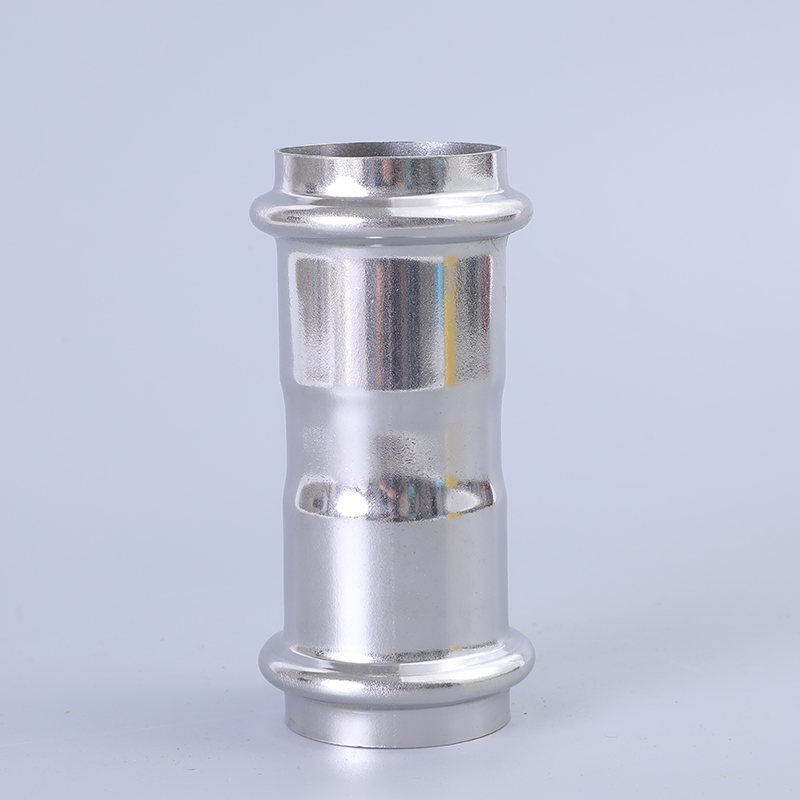
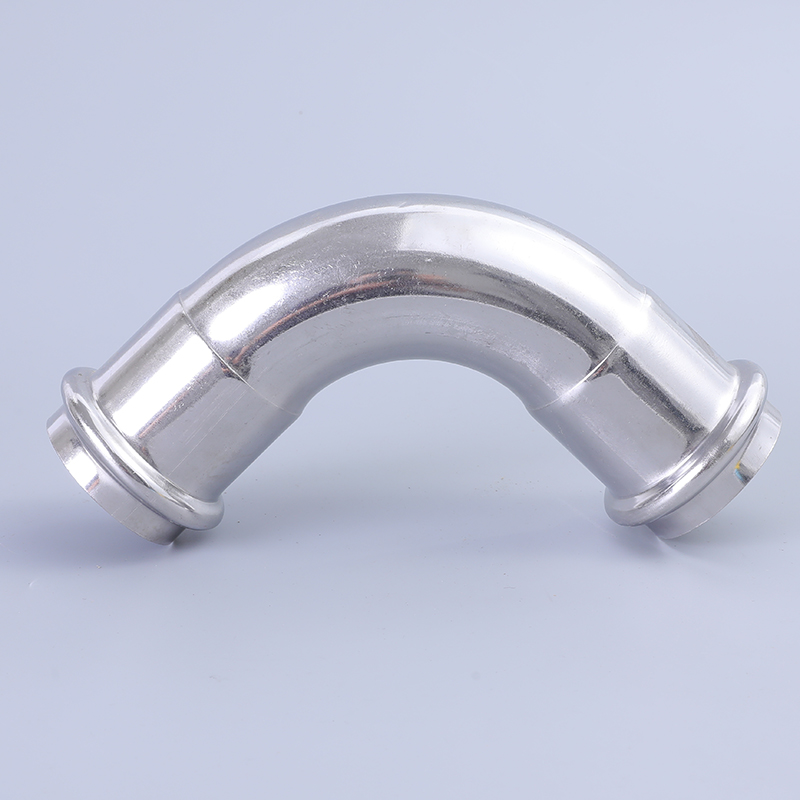
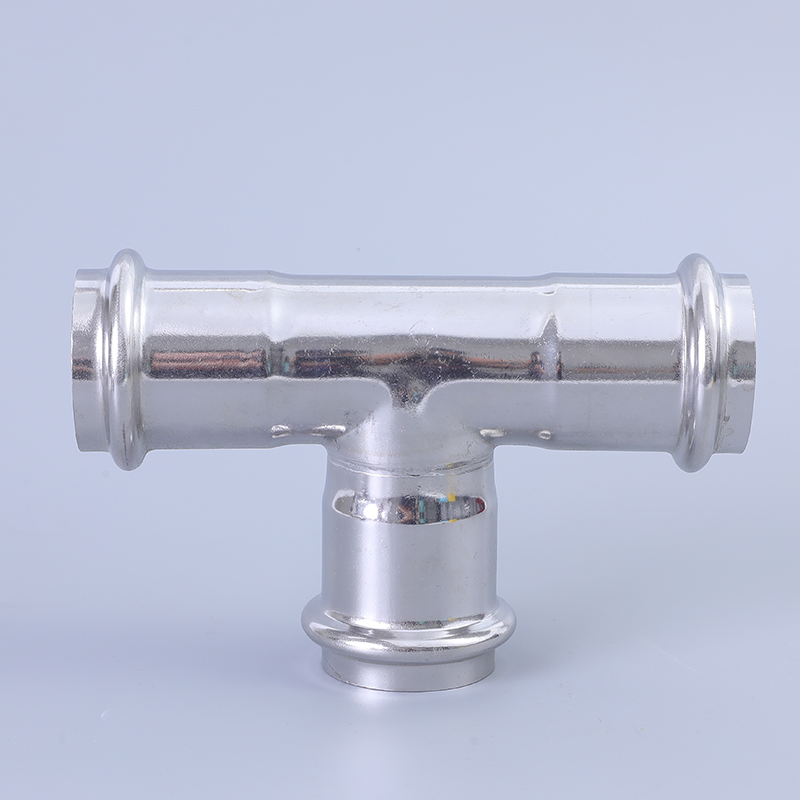
GB Double-press Fittings are stainless steel press fittings manufactured by WENZHOU ZHENGXIN PIPE FITTINGS CO., LTD, a manufacturer based in Wenzhou, China, focused on water supply pipeline systems for residential, public construction, gas supply and direct-drinking water applications. They are supplied in 304 and 316L stainless steel, in a press-fit elbow, coupling and tee family, and they are declared compliant with EN 10312 and CE certified.
Material grade: 304 (06Cr19Ni10) or 316L (022Cr17Ni12Mo2)
Both grades are available across the same product family, at the same published diameters and the same published pressure and temperature ratings. That is a useful planning fact: changing grade does not force a change to the pipe schedule or to the pressing tools.
Selection logic for residential work is straightforward. Grade 304 is the standard choice for treated municipal potable water in residential risers, branch lines and metering areas. Grade 316L is a molybdenum-bearing austenitic grade that generally offers higher resistance to chloride-related corrosion, so it is normally specified where water chemistry, stagnation behaviour or ambient exposure raises the risk of chloride attack — for example certain coastal or aggressive-water locations, or where the project specification already calls for 316L.
Diameter coverage: DN15 (φ16) to DN100 (φ108)
The GB Double-press range covers suitable pipe outer diameters from DN15 (φ16) up to DN100 (φ108). In a residential building this spans small branch take-offs through to the main riser sizes, so the primary check is a drawing-set check: list every press diameter on the plumbing and gas drawings and confirm each one falls inside the range before the fitting schedule is released. Any diameter outside the range would need a different joining method for that segment.
The fitting family is not limited to plain couplings. Alongside press-fit elbows, couplings and tees, the range includes threaded transitions such as male and female thread couplings and thread tees, unions, end caps and flange couplings — the components that connect press-fit pipework to pumps, valves, meters and equipment without introducing welded adapters into a concealed space.
Sealing material: EPDM or food-grade silicone
Sealing ring selection is a media and temperature decision, not a cost decision:
- EPDM — temperature and oil resistant, and specified by the manufacturer as suitable for potable water and gas supply systems.
- Food-grade silicone — FDA certified, used for hygienic and direct-drinking water applications.
Temperature capability differs between the ordinary and high-temperature models. The ordinary model is rated from -20℃ to 95℃. A high-temperature resistant model extends the range to -40℃ to 120℃, but requires replacement of the sealing ring to reach that range. This is the single most common specification error in residential hot-water lines: the fitting body and the gasket are treated as one item when they are not.
Pressure and temperature envelope
The published working pressure for GB Double-press Fittings is 1.6 MPa for cold water and 1.0 MPa for hot water at ≤95℃, with a working temperature of -20℃ to 95℃ for the ordinary model. The fitting is described as high pressure resistant and resistant to thermal expansion and contraction, which matters on residential hot-water risers where repeated heating and cooling cycles are continuous rather than occasional.
Specification reference for GB Double-press Fittings
| Specification item | GB Double-press Fittings |
|---|---|
| Material | 304 stainless steel (06Cr19Ni10) / 316L stainless steel (022Cr17Ni12Mo2) |
| Suitable pipe outer diameter | DN15 (φ16) – DN100 (φ108) |
| Working pressure | 1.6 MPa (cold water) / 1.0 MPa (hot water, ≤95℃) |
| Working temperature | -20℃ – 95℃ (ordinary model); -40℃ – 120℃ (high-temperature resistant model, requires replacement of sealing ring) |
| Sealing material | Food-grade silicone (FDA certified) / EPDM (temperature and oil resistant) |
| Connection type | Press-fit (double-press); no welding required |
| Declared compliance | EN 10312; CE certified |
| Typical applications | Urban residential buildings; public constructions; gas supply systems; direct-drinking water systems |
Step-by-Step Breakdown: From Drawing Set to Pressure-Tested Pipeline
The following sequence converts a residential specification into an installed, tested system. Steps 1–5 belong to the buyer and specifier; steps 6–8 belong to the installing contractor.
- Split the building into piping segments. Separate domestic cold water risers, hot water risers, direct-drinking water lines and gas lines, and treat each as a separate specification block, because sealing ring and material grade requirements differ between them.
- Assign a material grade per segment. Grade 304 for standard treated municipal potable water; grade 316L where the water chemistry or exposure conditions justify higher chloride resistance.
- Verify diameter coverage on the drawings. Confirm that every press diameter in the plumbing and gas drawing set falls within DN15 (φ16) to DN100 (φ108), and identify any segment that would need an alternative joining method.
- Select the sealing ring. EPDM for potable water and gas service within the ordinary temperature range; FDA-certified food-grade silicone for direct-drinking and hygienic applications; the high-temperature sealing ring configuration for the -40℃ to 120℃ model.
- Check the pressure and temperature envelope. Compare the system design pressure and the hot-water supply temperature against the published 1.6 MPa cold water rating and 1.0 MPa hot water rating at ≤95℃.
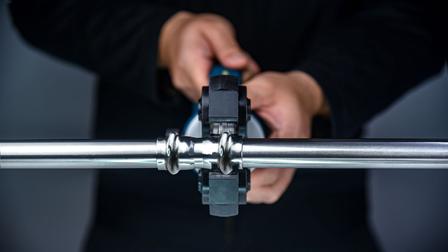
- Confirm tooling and the double-press procedure. Match the fitting to the pressing jaws available on site, and confirm that the crew understands the correct jaw position on the fitting groove and full jaw closure at the end of the press.
- Validate on a sample before bulk delivery. Press a trial assembly using the project's own tooling and the actual pipe, then pressure test it. This catches jaw, depth-mark and deburring problems while they are still cheap to fix.
- Install to the standard sequence and pressure test. Cut the pipe squarely and deburr inside and outside; mark insertion depth; insert the pipe fully to the mark; position the jaws at the groove; press until the jaws close completely; then pressure test the system to confirm no leakage.
Use Cases: Where These Fittings Are Specified in Urban Residential Projects
GB Double-press Fittings are intended for the urban residential buildings industry and are also applied in public construction, gas supply systems and direct-drinking water systems. In residential developments they are typically specified for:
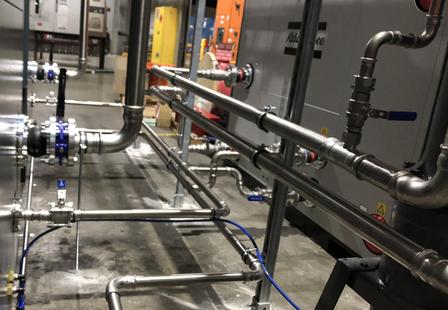
- Domestic cold and hot water risers — continuous 24/7 duty, with the leak-proof, corrosion-resistant and potable-water hygienic requirements of a concealed installation.
- Direct-drinking water systems — where the hygienic sealing configuration and stainless steel wetted surfaces are the deciding factors.
- Building gas supply lines — using the EPDM sealing configuration specified by the manufacturer as suitable for gas supply systems.
- Public construction, hotel and hospital projects — the same fitting family and the same installation procedure, with higher hygiene and reliability expectations.
A representative application case records 12,000 pieces installed in potable water plumbing systems, used by plumbing distributors and construction contractors. The objective in that project was to address corrosion and leakage problems common in potable water plumbing systems, and the reported result was corrosion-resistant, leak-free pipeline operation, with fast installation, no welding, and long service life. The case reference lists a service duration of 15+ years, with installations in markets including Germany, Spain, France, Italy, the United Kingdom, Australia, Indonesia, Thailand, Taiwan, Belarus and Russia.
Comparison: Press-Fit Against Socket Weld, and Grade Against Grade
Two comparisons decide most residential specifications: which joining method to use, and which material and sealing combination to buy. Both tables below use manufacturer-published data only.
Joining method: GB Double-press Fittings vs Socket Weld Fittings
| Comparison item | GB Double-press Fittings | Socket Weld Fittings |
|---|---|---|
| Joining principle | Pressed mechanical connection; no welding required | Welded socket connection, forged integral forming |
| Standard reference | Declared compliant with EN 10312; CE certified | Manufactured in accordance with GB/T 14383-2021, compatible with ASME B16.11 |
| Size range | DN15 (φ16) – DN100 (φ108) | DN6 – DN100 (NPS 1/8'' – 4'') |
| Pressure class | 1.6 MPa cold water / 1.0 MPa hot water (≤95℃) | Class 3000#, Class 6000#, Class 9000# |
| Working temperature | -20℃ – 95℃ ordinary; -40℃ – 120℃ high-temperature model | -20℃ – +450℃ |
| Applicable media | Potable water, gas, direct-drinking water | Water, oil, gas, steam |
| Best-fit conditions | Residential potable water risers, concealed pipework, direct-drinking lines, projects where hot work is restricted | High-pressure and high-temperature working conditions; industrial piping systems requiring maximum joint stiffness |
| Installation demand | Square cut, deburr, depth mark, full insertion, matched jaws, complete press, pressure test | Pipe alignment and welding; higher skill and time demand; welded joint is anti-vibration with low leakage risk |
Selection matrix: material grade and sealing material
| Selection item | Option | Key published data | Where it fits |
|---|---|---|---|
| Material grade | 304 stainless steel (06Cr19Ni10) | Same DN15 (φ16) – DN100 (φ108) range and same pressure/temperature ratings as 316L | Standard treated municipal potable water in residential risers and branches |
| Material grade | 316L stainless steel (022Cr17Ni12Mo2) | Molybdenum-bearing austenitic grade; same range and ratings | Lines where chloride exposure raises corrosion risk, or where the project specification calls for 316L |
| Sealing ring | EPDM | Temperature and oil resistant; specified as suitable for potable water and gas supply systems | Domestic water and building gas service within -20℃ – 95℃ |
| Sealing ring | Food-grade silicone | FDA certified | Direct-drinking water and hygienic applications |
| Sealing ring | High-temperature sealing ring | Required for the -40℃ – 120℃ high-temperature resistant model | Elevated-temperature duty where the ordinary model range is insufficient |
Quality Control and Supply Capacity Behind a Residential Order
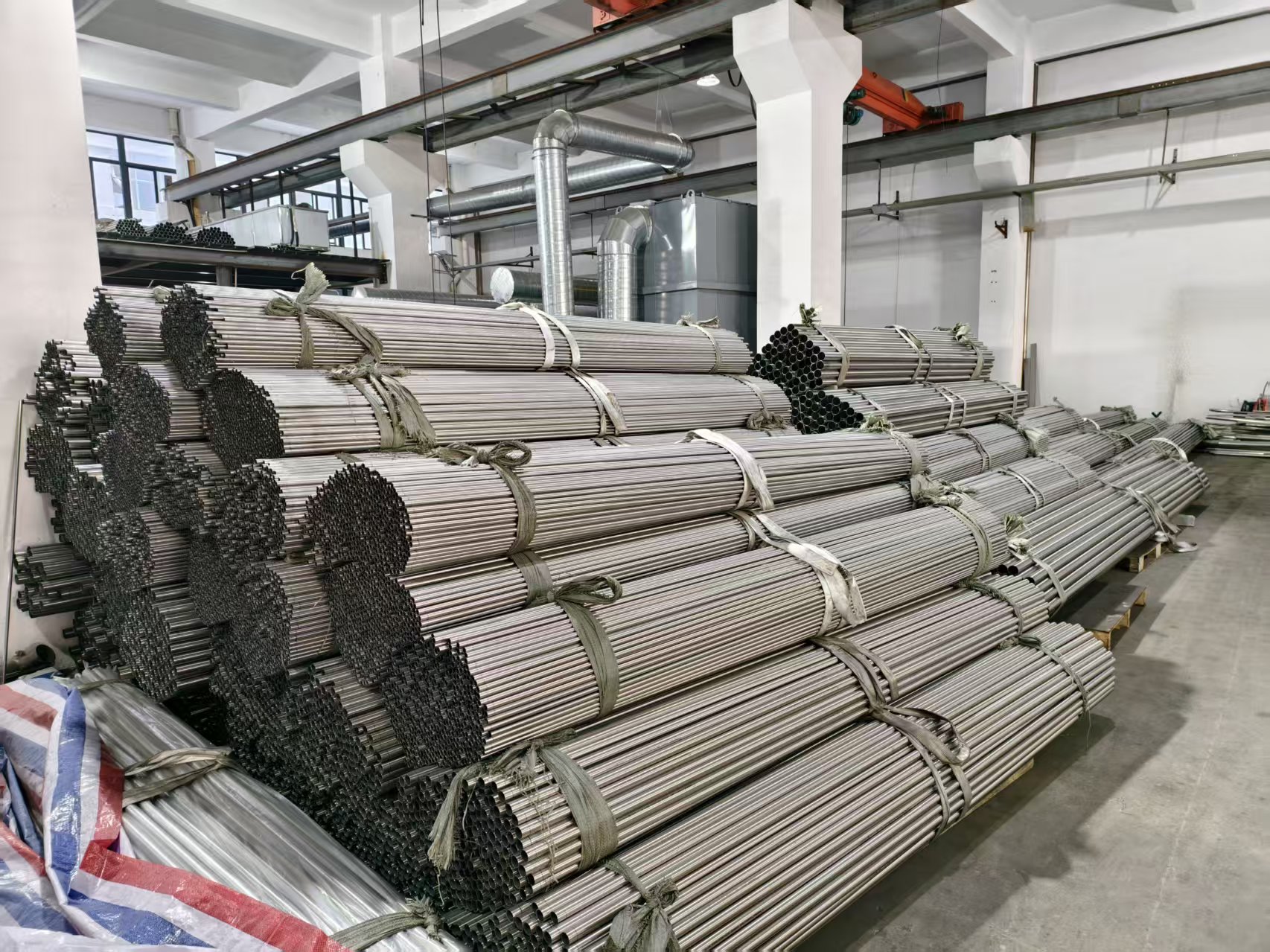
Residential programmes fail on delivery as often as on specification, so the supply side belongs in the selection decision. WENZHOU ZHENGXIN PIPE FITTINGS CO., LTD was founded in August 2013 and operates a 9,000 m² factory with 70 employees and an R&D team of 10 engineers. The company has introduced the QS9000 production management system, has passed ISO 9001:2000 quality management system certification, and its products are CE certified.
- Quality control: 100% visual inspection and pressure testing.
- Monthly capacity: 83,000 pieces of fittings and 83 tons of pipes.
- Annual capacity: 1,000,000 stainless steel pipe fittings and 1,000 tons of stainless steel pipes, with annual output value exceeding RMB 100 million.
- Lead time: 25–40 days.
- Minimum order quantity: 100 pieces.
- Customization: OEM/ODM including logo, size, material and packaging.
- After-sales: remote technical support and installation guidance.
- Export profile: approximately 70% export ratio, with Europe as the main market and additional activity in Southeast Asia and the Middle East.
FAQ: Press Fitting Selection for Urban Residential Projects
Do GB Double-press Fittings meet the standards expected on European residential potable water projects?
GB Double-press Fittings are declared compliant with EN 10312 and are CE certified, and they are supplied in 304 (06Cr19Ni10) and 316L (022Cr17Ni12Mo2) with EPDM or FDA-certified food-grade silicone sealing rings. European residential specifications commonly reference EN 10312 for plumbing and EN 10217-7 for welded stainless tubes, and technical documentation for stainless tube also cites DVGW W541 for potable water service. Buyers should also confirm profile compatibility with the pressing tools available on site, because both M Profile and V Profile are widely used across Europe and both are recognised as valid under the same regulations.
How do we choose between 304 and 316L stainless steel for a residential building?
Both grades are available in the same size range, DN15 (φ16) to DN100 (φ108), with the same published ratings: 1.6 MPa cold water, 1.0 MPa hot water at ≤95℃, and -20℃ to 95℃ for the ordinary model. Grade 304 is the standard choice for treated municipal potable water in residential risers. Grade 316L contains molybdenum and generally provides higher resistance to chloride-related corrosion, so it is normally specified where water chemistry or site exposure increases that risk, or where the project specification already requires it. Because diameters and ratings are identical, switching grade does not change the pipe schedule or the pressing tools.
Which sealing ring should be specified — EPDM or food-grade silicone?
EPDM is temperature and oil resistant and is specified by the manufacturer as suitable for potable water and gas supply systems, which makes it the common choice for domestic water and building gas lines within the -20℃ to 95℃ range. Food-grade silicone is FDA certified and is used for hygienic and direct-drinking water applications. Where the line requires the high-temperature resistant model, the published range is -40℃ to 120℃ and the sealing ring must be replaced to reach it. In every case, the gasket is the component most sensitive to installation quality, so sealing performance depends on correct cutting, deburring, insertion depth and jaw alignment as much as on the material selected.
What drives the installed cost of a press-fit domestic water system in a residential project?
The main cost drivers are the material grade (304 or 316L), the mix of diameters required across the drawing set, the sealing ring configuration, the tooling the contractor must own or rent, and the total order scale. The commercial argument for press-fit is not a lower unit price — it is the installation profile: fast and easy installation with no welding required, and a design intent of maintenance-free operation with a service life matching the service life of the building, which reduces long-term operation cost in concealed installations. Project pricing is calculated from the DN bill of materials rather than from a catalogue unit price.
Can we validate the fittings on a sample before ordering for a full residential project?
Yes. The minimum order quantity is 100 pieces, and OEM/ODM customization is available for logo, size, material and packaging, so a project-specific sample configuration can be produced. The most useful validation is a trial press using the project's own tooling and pipe: cut squarely, deburr, mark insertion depth, insert fully, position the jaws correctly, press until the jaws close completely, then pressure test. That sequence reproduces the installation conditions on site and exposes tooling or workmanship issues before bulk delivery. Remote technical support and installation guidance are provided after delivery.
What lead time and production capacity should a residential project plan for?
Standard lead time is 25–40 days, supported by a monthly capacity of 83,000 pieces of fittings and 83 tons of pipes, and an annual capacity of 1,000,000 stainless steel pipe fittings and 1,000 tons of stainless steel pipes. Every order passes 100% visual inspection and pressure testing before shipment, which supports a stable lead time across a multi-phase residential programme. To start a project-specific quotation, share the DN schedule, material grade and sealing ring selection, and the technical team will respond with the matching bill of materials.
Conclusion
Selecting press fittings for an urban residential building comes down to closing six variables before procurement: material grade (304 or 316L), diameter coverage (DN15 (φ16) to DN100 (φ108)), sealing material (EPDM or FDA-certified food-grade silicone), the pressure and temperature envelope (1.6 MPa cold water, 1.0 MPa hot water at ≤95℃, -20℃ to 95℃ ordinary), a joining method that matches the tooling on site, and a supply chain that can hold the programme.
GB Double-press Fittings address those variables as a single specification package: a double-press connection with no welding required, declared compliance with EN 10312 and CE certification, 304 and 316L material options, and EPDM or food-grade silicone sealing for potable water, direct-drinking water and gas service in residential, public construction, hotel and hospital projects. Because concealed pipework is the hardest part of a building to reopen, the value of getting this specification right is measured over the life of the building rather than at handover.
Next Step: Sample, Quotation and Technical Documents
WENZHOU ZHENGXIN PIPE FITTINGS CO., LTD supplies GB Double-press Fittings, European standard press fittings, socket weld and grooved quick-assembly pipeline products to residential, public construction and industrial projects, with an approximately 70% export ratio and Europe as the main market.
- Download the full product range: Product Catalog (PDF)
- Website: www.zxpipeindustry.com
- Sample and quotation requests: Cindy — cindy@zxpipeindustry.com — Tel / WhatsApp / WeChat: +86 18966285772
- WhatsApp: Start a conversation
Send your DN schedule, material grade and sealing ring requirement, and the team will return a matching bill of materials and lead-time confirmation.
Have Questions or Need More Details?
Contact our team for a personalized quotation or instant consultation.
Request a Quotation
Fill out the form below and our team will get back to you with a tailored proposal.
WhatsApp Direct Chat
Prefer to chat in real-time? Message us on WhatsApp for instant assistance & quick answers.
- Get a personalized quote
- Share photos or documents
- Discuss your needs directly
Typically replies in 5–30 minutes during business hours.