Stainless Steel Press Fittings Application Guide: Double-Press vs Socket Weld by Scenario
Choose the joint type from the scenario, not from habit. Double-press press-fit fittings are the default for potable water, direct-drinking water, heating and gas distribution lines in DN15–DN100, because they close without open flame and without a welder-qualification bottleneck. Socket weld fittings — supplied in 304 or 316L stainless steel and made to GB/T 14383-2021 — remain the correct choice for steam, high-vibration duty, and any pipeline where the specification calls for a permanent welded joint.
This guide is written for procurement managers, MEP contractors, distributors and brand owners who must lock a joining method before the bill of materials is issued. It maps three fitting families from WENZHOU ZHENGXIN PIPE FITTINGS CO., LTD — European standard press fittings, GB Double-press Fittings (Series 1 and Series 2), and socket weld fittings — to four project scenarios: direct-drinking water systems, urban residential buildings, gas supply systems, and public constructions. It then gives the compliance and compatibility checks to complete before the first purchase order.
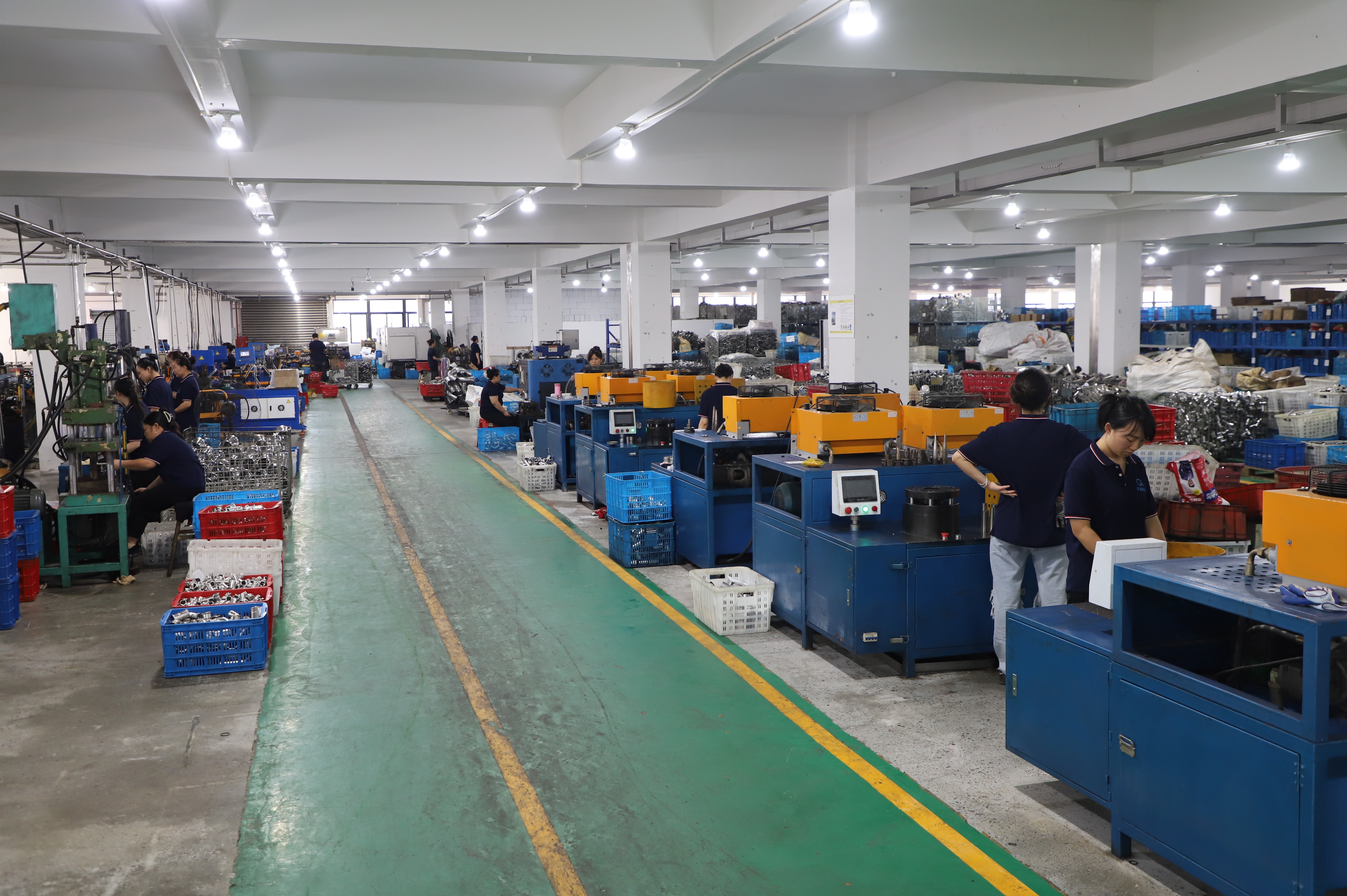
WENZHOU ZHENGXIN PIPE FITTINGS CO., LTD (Zhengxin Pipe Industry) is a manufacturer based in Wenzhou, China, founded in August 2013, producing European-standard single press-fit fittings, Chinese-national-standard double press-fit Series 1 and Series 2 fittings, plus socket-weld and grooved quick-assembly metal pipeline systems. Around 70% of its output is exported, with Europe as its main market, and its products are CE-certified.
Problem Definition: The Joint Type Is Usually Decided by Default, Not by Scenario
Two fittings that read identically on a bill of materials can fail in completely different ways. Double-press fittings and socket weld fittings are both supplied in DN15 (φ16) to DN100 (φ108) pipe-outer-diameter steps, both are available in 304 stainless steel (06Cr19Ni10) and 316L stainless steel (022Cr17Ni12Mo2), and both are usually listed on drawings under one generic line: stainless steel fitting. What separates them is not appearance. It is medium compatibility, temperature window, profile and tooling, permanence of the joint, and who carries responsibility for that joint over the life of the building.
Four failure patterns repeat across water and gas projects:
- Profile mixing. European standard M-profile press fittings and Chinese standard V-profile press fittings have different press-groove dimensions and unmatched sealing-ring grooves. The pressing jaws cannot be shared, and forced assembly creates poor sealing, leakage, or pipe-disconnection risk.
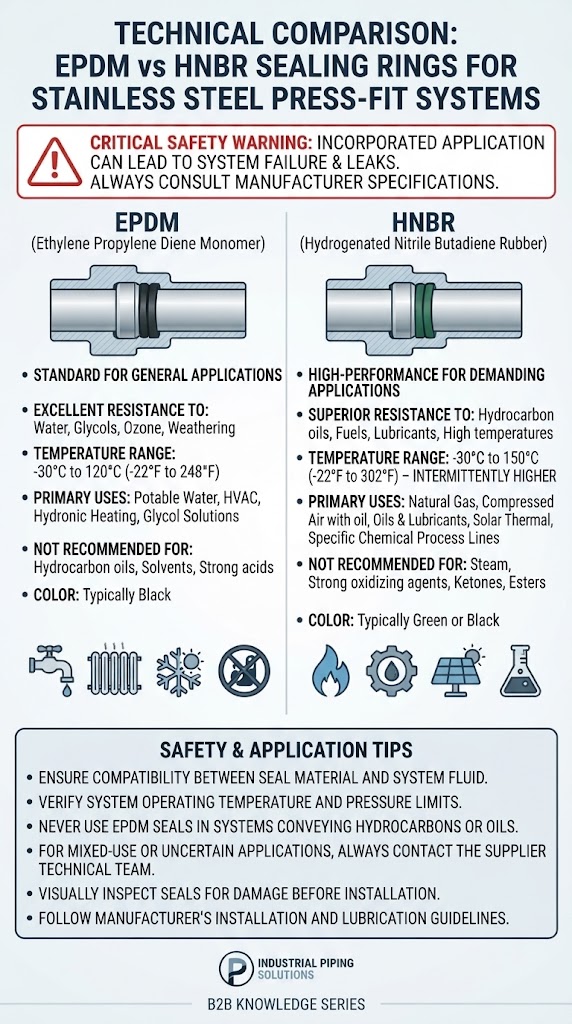
- Gasket cross-use. A water-service EPDM gasket used on a gas line ages rapidly and produces a dangerous leakage path. Gas and oil-gas media require HNBR sealing rings; drinking-water and drainage duty uses EPDM or food-grade silicone.
- Rating drift. A fitting rated 1.6 MPa for cold water is not automatically a 1.6 MPa hot-water component. The same family is rated 1.0 MPa for hot water up to 95°C, and service between -40°C and 120°C requires the high-temperature model with the matching sealing ring.
- Re-pressing a deformed joint. Secondary pressing on an already deformed fitting does not restore the seal. Once a joint has been pressed incorrectly, it must be cut out and remade.
Every one of these is an ordering-stage decision. After installation, the same issues become repair costs rather than specification choices.
Industry Background: Press-Fit Is Now the Default, Welding the Exception
The global stainless steel press fitting market was valued at USD 3.8 billion in 2025 and is expected to reach USD 6.4 billion by 2034, growing at a CAGR of 6.0% (Dataintelo). Within that total, the stainless steel sub-sector was estimated at approximately USD 1.03–1.30 billion for 2024, equivalent to roughly 29%–38% of the overall press fitting market (Global Industry Reports).
In Europe, the pressing geometry is standardised in practice rather than in competition: M Profile and V Profile are the two dominant profiles, and M Profile is available up to 168.3 mm diameter (Eurotubi). Both are valid and comply with the same regulations — which is precisely why profile discipline, not profile preference, is what protects a project. Stainless steel tube used for pressure purposes is specified against EN 10217-7, and plumbing systems against EN 10312 (Isotubi technical specifications).
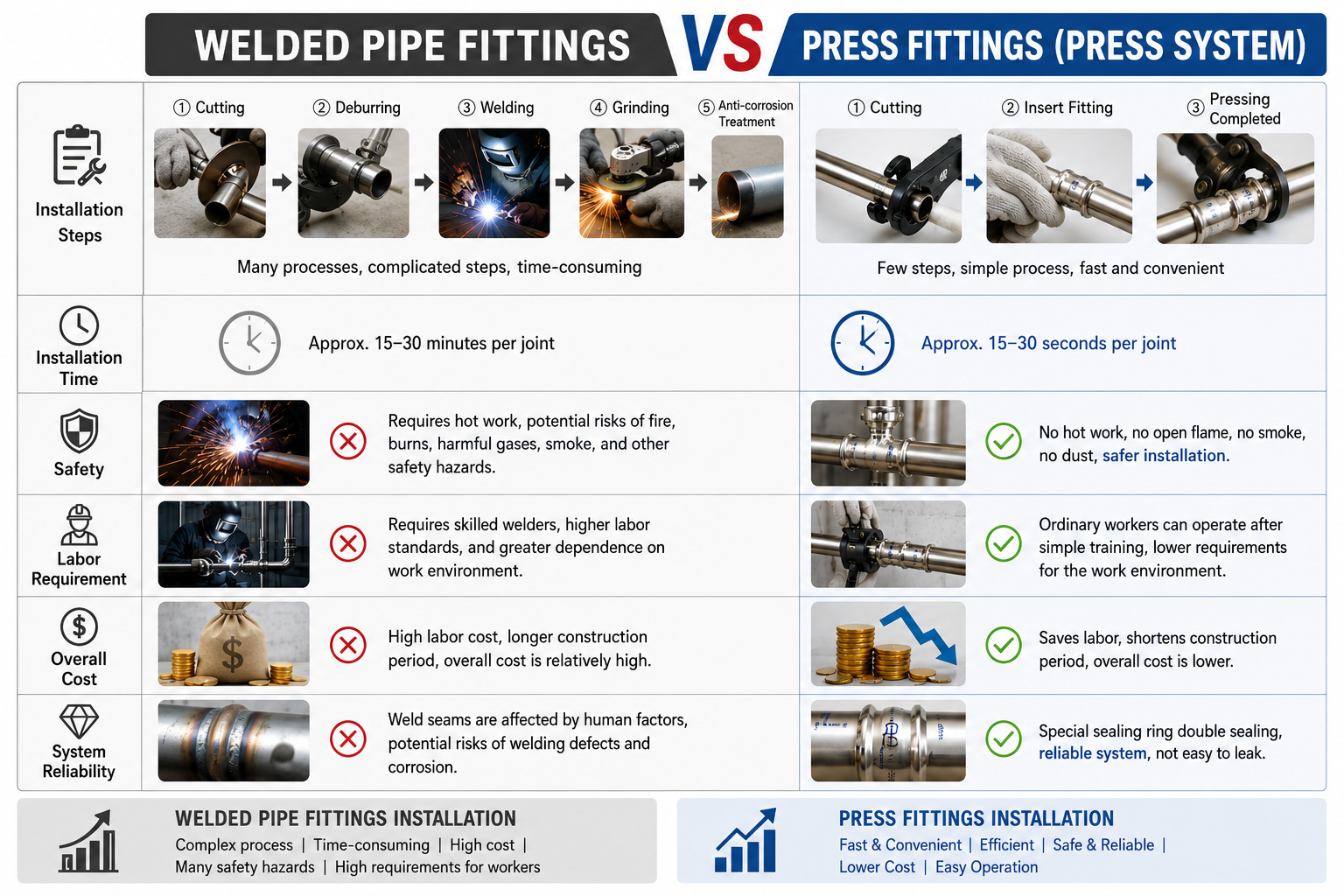
The commercial consequence is simple. Press joining removed the open-flame hot-work permit and the qualified-welder bottleneck from a large share of building services work, and the remaining welded scope is now concentrated where welding genuinely earns its place: permanent joints, steam, high-vibration duty, and specification-mandated welds.
The Three Fitting Families in This Comparison
European standard press fittings (EN Standard Series)
Euro-spec stainless press elbows, press couplings and press tees for European-standard press systems. They use an M-profile geometry and are matched to European pressing tools, which is the practical reason they are specified on EU-facing projects rather than domestic-standard components.
GB Double-press Fittings (GB Series)
Chinese-national-standard double press-fit Series 1 and Series 2 fittings, also supplied as elbows, couplings and tees. Double-press geometry creates two compression points per joint, and the Series 1 / Series 2 split follows the Chinese national standard pipeline system the project is built to. They are widely used for urban residential buildings, gas supply systems and public constructions in the domestic market and in export markets that specify GB systems.
Socket weld fittings
Socket weld fittings are supplied in 304 stainless steel or 316L stainless steel and are manufactured to GB/T 14383-2021. The pipe is inserted into a socket and welded, producing a permanent joint that does not depend on an elastomeric sealing ring, a press profile, or a battery-powered tool. That permanence is the reason socket weld fittings stay in scope for steam, high-temperature, high-vibration and specification-mandated welded pipelines.
| Family | Materials | Size range | Working pressure | Working temperature | Sealing element | Typical applications |
|---|---|---|---|---|---|---|
| European standard press fittings (EN Standard Series) | 304 (06Cr19Ni10) / 316L (022Cr17Ni12Mo2) | DN15 (φ16) – DN100 (φ108) | 1.6 MPa cold water / 1.0 MPa hot water | -20°C to 95°C ordinary; -40°C to 120°C high-temperature model (requires sealing-ring replacement) | Food-grade silicone (FDA certified) / EPDM | Direct-drinking water systems; urban residential buildings; gas supply systems; public constructions |
| GB Double-press Fittings (GB Series) | 304 (06Cr19Ni10) / 316L (022Cr17Ni12Mo2) | DN15 (φ16) – DN100 (φ108) | 1.6 MPa cold water / 1.0 MPa hot water | -20°C to 95°C ordinary; -40°C to 120°C high-temperature model (requires sealing-ring replacement) | Food-grade silicone (FDA certified) / EPDM | Urban residential buildings; gas supply systems; public constructions |
| Socket weld fittings | 304 stainless steel / 316L stainless steel | Per project pipe schedule | Defined by pipe wall thickness and welding procedure | Selected for high-temperature and steam service | None (welded metal joint) | Steam, high-vibration, high-temperature and specification-mandated permanent pipelines |
Decision Rule 1: Match the Joint to the Medium
Medium is the first filter, because it decides both the joint type and the sealing ring. Getting the gasket wrong is the single most common cause of a technically compliant installation that still leaks.
| Medium | Recommended joint | Sealing ring | Constraint to check before ordering |
|---|---|---|---|
| Potable water, direct-drinking water | Double-press (EN or GB family) | Food-grade silicone (FDA certified) or EPDM | Hygienic potable-water requirement; no flame, no flux residue inside the bore |
| Hot water and heating up to 95°C | Double-press (EN or GB family) | EPDM | Hot-water rating is 1.0 MPa, not 1.6 MPa |
| High-temperature water up to 120°C | Double-press high-temperature model | High-temperature sealing ring (standard ring must be replaced) | Confirm the -40°C to 120°C model on the order line |
| Gas and oil-gas media | Double-press with gas-rated sealing | HNBR (mandatory for gas and oil-gas) | Never cross-use a water-service EPDM gasket on gas |
| Oil and oily compressed air | Double-press with oil-resistant sealing | HNBR | Medium-to-gasket match takes priority over price |
| Steam and high-temperature process lines | Socket weld fittings | None (welded joint) | Press fittings only within the rated window, using the high-temperature sealing ring |
Decision Rule 2: Match the Joint to the Scenario
Direct-drinking water systems
Press-fit is the natural fit here. The joint is formed outside the pipe bore with a mechanical jaw, so there is no weld spatter, no flux and no open flame inside a hygienic line. Specify food-grade silicone (FDA certified) or EPDM sealing rings, confirm the 1.6 MPa cold-water rating for the distribution main, and keep pipe-end deburring and insertion-depth marking as mandatory site steps. Where a specification requires a permanent welded joint for a plant room header, socket weld fittings in 304 or 316L remain available in the same project.
Urban residential buildings
Riser and floor-distribution lines in residential buildings are the highest-volume press-fit scenario, and the deciding factor is speed per floor. Press joining is reported at 70% faster installation than welded connections, with lower on-site labour cost and minimal welding repair. Use the GB Double-press Fittings family where the project is built to the Chinese national standard system, and European standard press fittings where an EN-based specification applies. Choose 304 stainless steel for normal tap water and dry compressed air; upgrade to 316L where the water is aggressive or the building is coastal.
Gas supply systems
Gas is a press-fit application with one non-negotiable condition: the sealing ring must be HNBR. Water-service EPDM ages rapidly in gas service and creates a leakage hazard. Press fittings are applicable to gas distribution in residential and public buildings within the rated pressure and temperature window; where the gas specification calls for welded joints, or where the line runs hot or is subject to heavy vibration, socket weld fittings are the correct substitution. For seaside gas projects, 316L is the recommended upgrade because 304 is prone to pitting corrosion in high-chloride conditions.
Public constructions
Hospitals, hotels, schools and municipal facilities combine all of the above in one site: potable water, hot-water circulation, gas, and plant-room pipework. The practical rule is to keep one profile system per circuit, document the gasket type on the drawing, and keep socket weld fittings reserved for steam, high-temperature and permanently welded runs. Mixed-technology sites fail through documentation, not through product choice — so the profile, material and gasket decision must appear on the isometric, not only on the purchase order.
Decision Rule 3: Material, Profile and Temperature Window
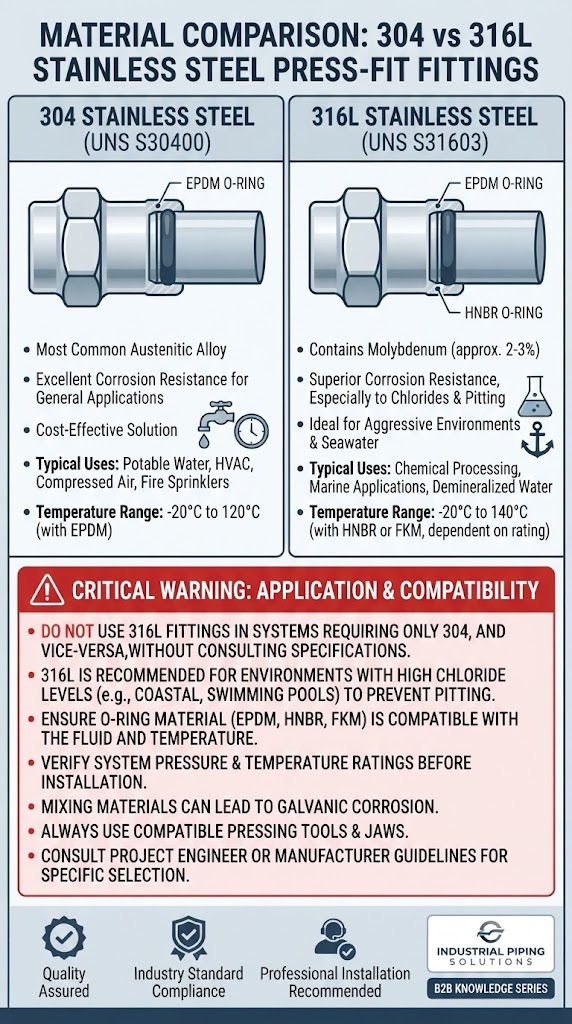
Material. 304 stainless steel is suitable for normal tap water, dry compressed air and general gas pipelines. 316L is recommended for seawater, weak acid-alkali, chemical and coastal high-chloride environments, because the molybdenum content improves chloride resistance while 304 is prone to pitting corrosion under high chloride exposure.
Profile. Euro-standard M-profile components and Chinese-standard V-profile components are not interchangeable. The sealing ring grooves do not match and pressing tools cannot be shared. Keep fittings, tubes and pressing jaws inside one profile system: M-profile for European-standard projects with M-type tools, V-profile for domestic and most Southeast Asian projects with V-type tools.
Temperature. The ordinary press-fitting model covers -20°C to 95°C. Service from -40°C to 120°C requires the high-temperature resistant model, and the sealing ring must be changed to the corresponding high-temperature type. Beyond that window — steam and high-temperature process duty — the joint moves to socket weld.
Step-by-Step: Executing a Project with Both Joint Types
Where a project uses press fittings for distribution and socket weld fittings for plant-room or steam duty, the sequence below keeps both scopes compliant.
- Fix the standard regime per circuit. Record on the drawing whether the circuit follows an EN-based press specification or a GB socket weld specification, and note the corresponding standard for each.
- Fix the profile per circuit. One profile system, one set of jaws. Never mix M-profile and V-profile components in the same pipeline system.
- Select material and gasket together. 304 or 316L by medium and environment; EPDM or food-grade silicone for water, HNBR for gas and oil-gas.
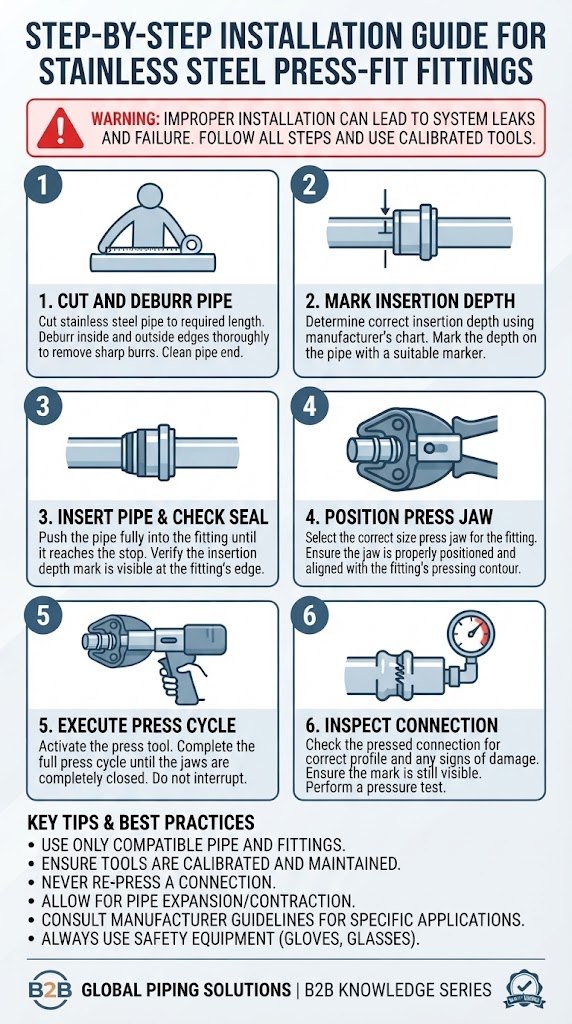
- Cut the pipe squarely and deburr. Cut the stainless pipe vertically and remove burrs from both the inner and outer edges thoroughly.
- Mark the insertion depth. Mark the depth on the pipe surface and insert the pipe fully into the fitting socket up to that mark.
- Position the jaws correctly. Place the matching tool jaws around the press-fit groove position and start pressing until the jaws close completely.
- Pressure-test. After installation, carry out a pressure test to verify that no joint leaks.
- Close out the socket weld scope. Weld the socket weld joints to the project welding procedure, then pressure-test the combined system before handover.
If leakage is found after pressing, the cause is almost always installation-related: burrs left on the pipe end scratching the gasket, insufficient insertion depth, mismatched or misaligned jaws, a damaged or aging sealing ring, or visible deformation of the pipe or fitting. Depressurise, inspect the joint, replace damaged components, cut the pipe squarely, remove all burrs, re-mark the depth, reinstall to the standard procedure, and pressure-test again. Never perform secondary pressing on an old deformed fitting.
Double-Press versus Socket Weld: Comparison Table
| Comparison criterion | Double-press (press-fit) | Socket weld |
|---|---|---|
| Joining method | Mechanical press with matched jaws; no open flame, no welding consumables | Pipe inserted into socket and welded; permanent metal joint |
| Materials | 304 (06Cr19Ni10) / 316L (022Cr17Ni12Mo2) | 304 stainless steel / 316L stainless steel |
| Size range | DN15 (φ16) – DN100 (φ108) | Per project pipe schedule |
| Working pressure | 1.6 MPa cold water / 1.0 MPa hot water | Defined by pipe wall thickness and welding procedure |
| Working temperature | -20°C to 95°C ordinary; -40°C to 120°C high-temperature model | Selected for steam and high-temperature service |
| Sealing element | Food-grade silicone (FDA certified), EPDM, or HNBR for gas and oil-gas | None — welded metal-to-metal joint |
| Installation speed | Reported 70% faster than welded connections, with lower on-site labour cost | Requires qualified welder and hot-work controls |
| Service life and maintenance | 15+ years service life; zero welding repair, minimal maintenance; smooth inner bore with low flow resistance | Permanent joint suitable for vibration, thermal cycling and steam duty |
| Best-fit media | Potable water supply, heating, gas distribution, commercial building plumbing | Steam, high-temperature process, high-vibration and specification-mandated welded lines |
| Standard reference | EN 10312 for plumbing systems and EN 10217-7 for welded tube for pressure purposes; CE certification for the EU market | GB/T 14383-2021 socket weld fittings |
Source note: press-fit and welded figures and service-life statements are drawn from Zhengxin’s press-fit versus welded connection comparison; EN 10217-7 and EN 10312 references are drawn from published European technical specifications; M Profile and V Profile availability from European press-fitting technical guidance.
Scenario Matrix: Final Selection and Compliance Checks
The matrix below closes the decision loop. Read it left to right: scenario, joint type, family, material, sealing ring.
| Scenario | Joint type | Family | Material | Sealing ring |
|---|---|---|---|---|
| Direct-drinking water systems | Double-press | European standard press fittings / GB Double-press Fittings | 304 or 316L | Food-grade silicone (FDA certified) or EPDM |
| Urban residential buildings (risers, floor distribution) | Double-press | GB Double-press Fittings (Series 1 / Series 2) or European standard press fittings | 304; 316L for aggressive or coastal water | EPDM (HNBR where gas is present) |
| Gas supply systems | Double-press, or socket weld where welded joints are specified | GB Double-press Fittings / European standard press fittings | 304; 316L for seaside gas projects | HNBR (no EPDM cross-use) |
| Public constructions (hospitals, hotels, municipal facilities) | Double-press for water and gas circuits; socket weld for steam and plant-room runs | Both families plus socket weld fittings | 304 or 316L by circuit | Per medium, documented on the isometric |
Pre-order compliance and compatibility checklist:
- Standard regime confirmed: EN 10312 and EN 10217-7 for EU press systems; GB/T 14383-2021 for socket weld fittings.
- CE certification confirmed for fittings placed on the European market.
- Profile consistency confirmed: M-profile fittings, tube and jaws together, or V-profile throughout — never mixed.
- Gasket confirmed against medium: food-grade silicone or EPDM for water, HNBR for gas and oil-gas.
- Material confirmed: 304 for normal water, dry compressed air and general gas; 316L for coastal, seawater, weak acid-alkali and chemical duty.
- Ratings confirmed: 1.6 MPa cold water, 1.0 MPa hot water up to 95°C; high-temperature model specified where -40°C to 120°C service applies.
- Installation method statement confirmed: square cut, full deburring, insertion-depth marking, matched jaws, pressure test.
- Commercial terms confirmed: MOQ 10 pcs; EXW / FOB / CIF delivery terms; 30% deposit and 70% balance before shipment; pre-shipment inspection with factory visual and dimensional checking.
FAQ
Do double-press fittings and socket weld fittings have to meet the same standards in a European project?
No — they sit in different standard regimes. European press systems are specified with reference to EN 10312 for plumbing and EN 10217-7 for welded stainless tube used for pressure purposes, and the fittings themselves are CE-certified for the EU market. Socket weld fittings are welded joints and, in GB-based projects, are manufactured to GB/T 14383-2021. Confirm which regime the drawing calls for before ordering, and do not mix an EN-specified press line with V-profile components from a different regime.
Can double-press fittings be used for gas, or should the project switch to socket weld?
Gas distribution in urban residential buildings and public constructions is a standard application for GB Double-press Fittings and European standard press fittings, provided the sealing ring is correct: HNBR is mandatory for gas and oil-gas media, and a water-service EPDM gasket must never be used. Switch to socket weld fittings when the gas specification requires welded joints, when service falls outside the press-fitting window (1.6 MPa cold water, 1.0 MPa hot water up to 95°C, or -40°C to 120°C with the high-temperature sealing ring), or when vibration and thermal cycling make a permanent joint preferable.
Can European standard M-profile press fittings be mixed with Chinese standard V-profile press fittings?
Mix-use is not recommended. M-profile and V-profile differ in press-groove dimension and sealing-ring groove, and the pressing tools cannot be shared between them. Forced assembly risks poor sealing, leakage, or pipe disconnection. Keep fittings, stainless steel tube and pressing jaws inside a single profile system: M-profile for European-standard projects using M-type tools, and V-profile for domestic and most Southeast Asian projects using V-type tools.
What are the commercial terms for a mixed order of double-press and socket weld fittings?
MOQ is 10 pcs. Delivery terms are EXW, FOB or CIF. Payment terms are 30% deposit with 70% balance before shipment. Acceptance is based on pre-shipment inspection with factory visual and dimensional checking. A quotation can be prepared against a bill of materials that lists profile, material, size and sealing ring for each line item.
How should a project validate a press fitting system before full installation begins?
Validate in three steps: order samples of the exact profile, material and gasket combination specified; confirm that the fittings, tube and pressing jaws belong to one profile system and that the sealing ring matches the medium; then install a short test run and pressure-test it before the main installation starts. Zhengxin supplies samples, provides the product catalogue for specification reference, and answers technical selection questions directly — contact Cindy at cindy@zxpipeindustry.com or +86 18966285772, or review the fittings range at www.zxpipeindustry.com.
Conclusion: Decide by Medium, Confirm by Standard, Then Order
For most building services work in DN15–DN100, the answer is double-press: it is flame-free, faster, and mechanically verifiable, and it covers potable water, direct-drinking water, heating and gas distribution when the sealing ring, material and profile are correctly specified. Socket weld fittings stay in the specification for steam, high-temperature and high-vibration duty, for specification-mandated welded pipelines, and wherever GB/T 14383-2021 governs the scope. The decision is only stable when three things are written down per circuit: the standard regime, the profile system, and the gasket type.
Next step: match the joint type to your project schedule
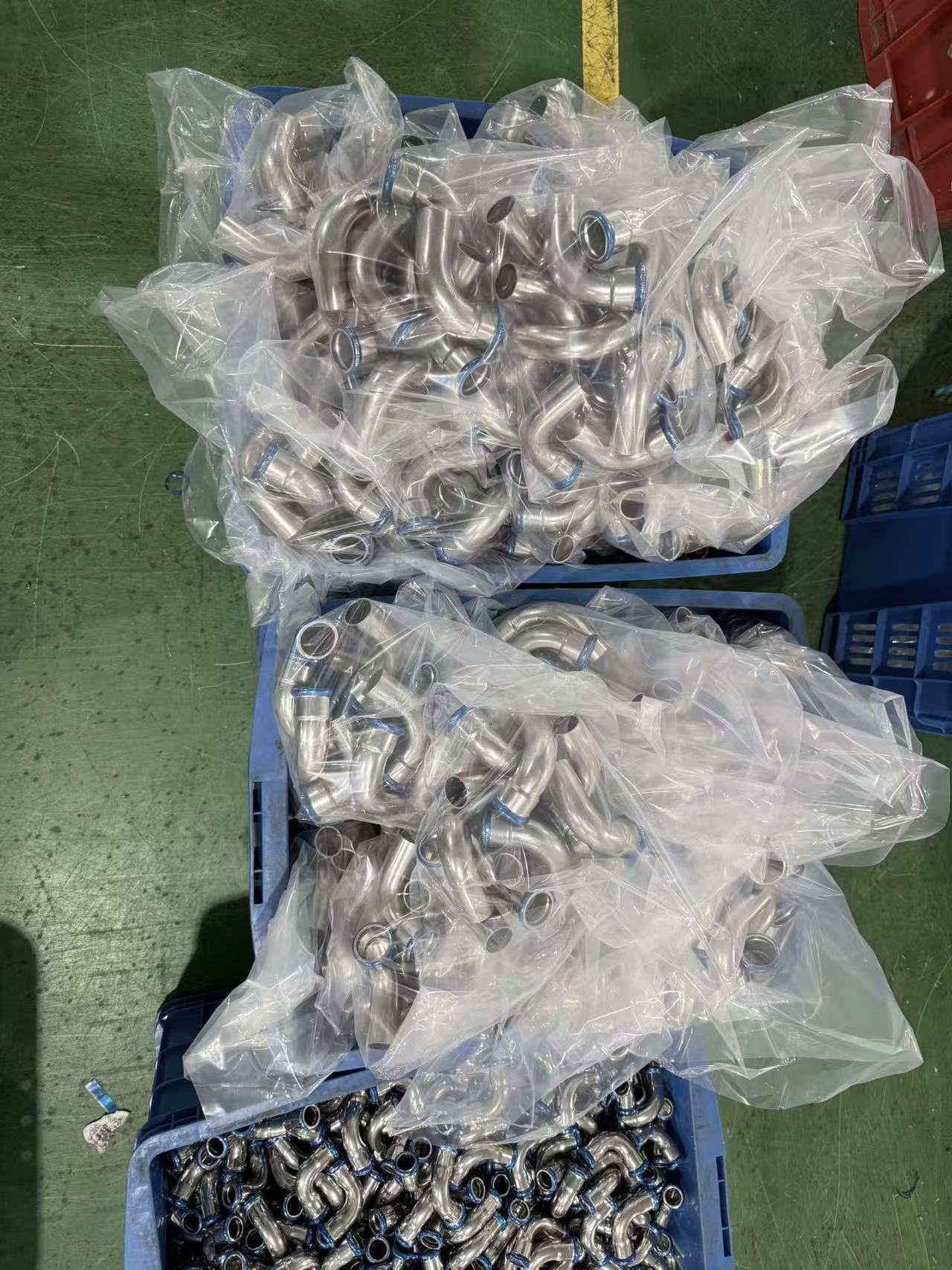
WENZHOU ZHENGXIN PIPE FITTINGS CO., LTD supplies European standard press fittings, GB Double-press Fittings (Series 1 and Series 2), and socket weld fittings in 304 and 316L stainless steel, from DN15 (φ16) to DN100 (φ108). Production capacity is 1,000,000 stainless steel pipe fittings per year across a 9,000 m² facility, with a 10-engineer R&D team supporting profile, material and gasket specification.
Request samples or a quotation: email Cindy at cindy@zxpipeindustry.com, call or WhatsApp +86 18966285772, or download the full product catalogue: Product Catalog (PDF).
Website: www.zxpipeindustry.com
Have Questions or Need More Details?
Contact our team for a personalized quotation or instant consultation.
Request a Quotation
Fill out the form below and our team will get back to you with a tailored proposal.
WhatsApp Direct Chat
Prefer to chat in real-time? Message us on WhatsApp for instant assistance & quick answers.
- Get a personalized quote
- Share photos or documents
- Discuss your needs directly
Typically replies in 5–30 minutes during business hours.