Pressure and Temperature Ratings for Stainless Steel Press Fittings
Pressure and temperature ratings on stainless steel press fittings form a single, coupled performance envelope rather than two independent numbers. A European-standard press fitting documented at 1.6 MPa holds that figure in cold-water service; the same fitting is documented at 1.0 MPa when the line carries hot water at up to 95 °C. The stainless steel body is seldom the limiting element - the elastomeric sealing ring is.
This technical guide explains how those figures are structured on EN-standard press fittings, what separates an ordinary model (-20 °C to 95 °C) from a high-temperature resistant model (-40 °C to 120 °C), and how pressure and temperature parameters map onto real project requirements in urban residential buildings, gas supply systems and public constructions. It is written for buyers and specifiers comparing supplier datasheets who need to know which parameter decides the selection.
Problem Definition: Why a Single Working-Pressure Figure Misleads Buyers
A datasheet that quotes one working-pressure value without a stated service condition is the most common source of mis-selection in press-fitting procurement. In a press joint, the rating is not a property of the metal alone: it is the combined capability of the fitting body, the tube, the sealing ring and the pressing geometry. Six variables decide whether a quoted figure still applies to your project.
- Temperature changes the allowable pressure. Elastomeric sealing rings soften as service temperature rises, so the pressure capability of the joint falls before the stainless steel does. This is why the same product family is documented at 1.6 MPa for cold water and 1.0 MPa for hot water at ≤95 °C.
- Below zero, the constraint shifts to the low-temperature limit. Ordinary models are documented from -20 °C. Applications exposed to lower ambient temperatures require the high-temperature resistant model, documented from -40 °C.
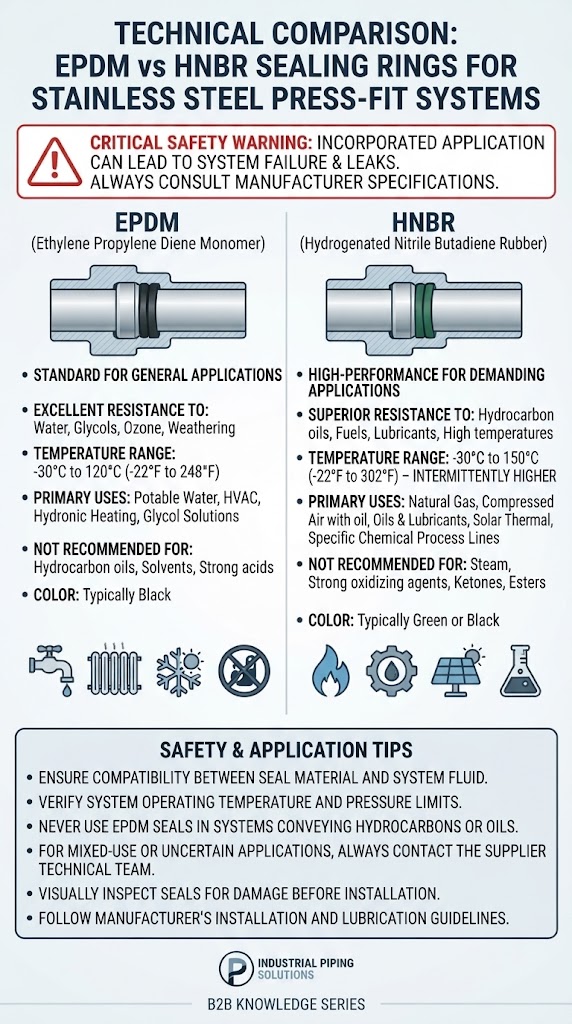
- The sealing ring must match the medium, not the pipe size. Food-grade silicone (FDA certified) and EPDM (temperature and oil resistant) are the documented sealing materials for water service. For gas and oil-gas media, an HNBR gasket is required: a water-service EPDM gasket in a gas line ages rapidly and creates a gas-leakage risk.
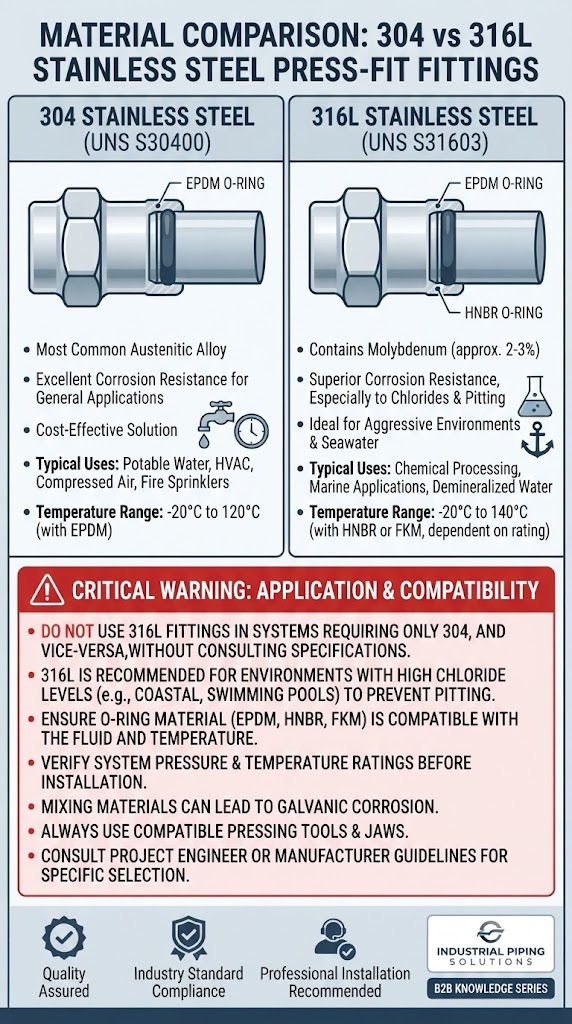
- Material grade governs corrosion life, not pressure class. 304 stainless steel suits normal tap water and dry compressed air. 316L stainless steel is recommended for seawater, weak acid-alkali, chemical and coastal high-chloride environments, where 304 is prone to pitting corrosion.
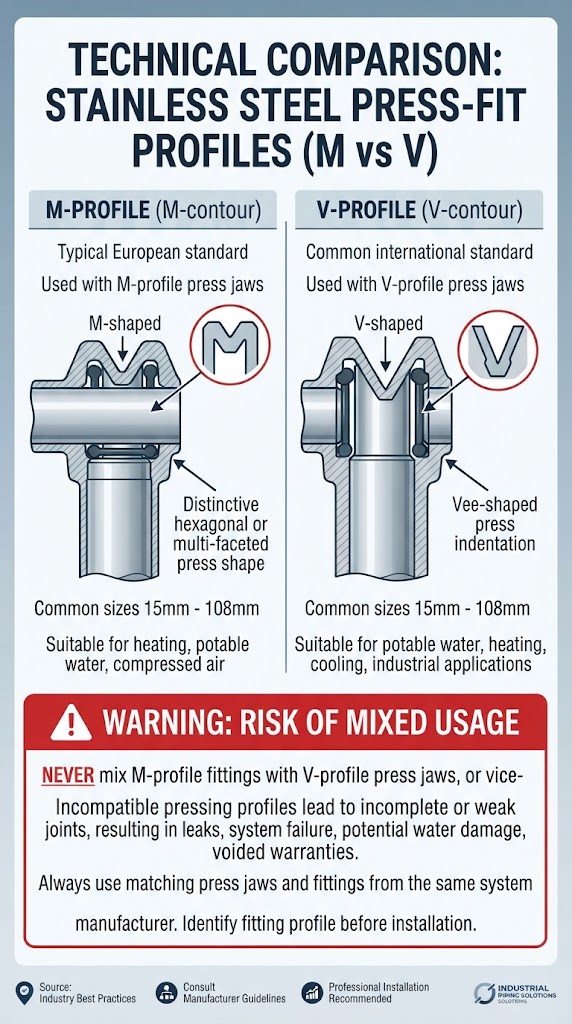
- Profile mismatch breaks the seal. Euro-standard M-profile and Chinese-standard V-profile press fittings have different press-groove dimensions and unmatched sealing-ring grooves. Forced assembly causes poor sealing, leakage or pipe disconnection.
- Installation quality sets the real-world margin. Burrs left on the pipe end, insufficient insertion depth, wrong or misaligned pressing jaws and damaged gaskets are the documented causes of leakage after pressing.
Industry Background: How Standards and Market Scale Frame These Ratings
Demand for stainless steel press fittings is large enough that rating accuracy has become a procurement issue rather than a technical footnote. Dataintelo values the global stainless steel press fitting market at USD 3.8 billion in 2025 and reports an expected USD 6.4 billion by 2034 at a CAGR of 6.0%. Global Industry Reports estimates the stainless-steel sub-sector at approximately USD 1.03-1.30 billion for 2024. The two estimates are not directly comparable - one covers the total press-fitting market in 2025, the other a stainless-steel sub-sector in 2024 - but both describe a category in which specification errors are expensive.
On the European side, the tube half of the joint is commonly specified to EN 10217-7 for pressure purposes and EN 10312 for plumbing applications. These standards define the welded stainless steel tube; the fitting half is governed by the press profile and by the pressure and temperature declaration the fitting manufacturer publishes. That declaration is what a buyer actually evaluates, which is why it should always be read against the service condition.
Two pressing geometries dominate in Europe. M Profile and V Profile are both valid and comply with the same underlying regulations, and the choice between them is frequently a matter of installer habit and available tooling. M Profile is available in Europe up to 168.3 mm (6 inch) diameter. What is not interchangeable is the profile itself: fittings, tubes and pressing jaws must belong to the same profile system.
Wenzhou Zhengxin Pipe Industry Co., Ltd. is a manufacturer of press-fit pipe fittings founded in 2013, operating a 9,000 m² facility with 70 employees, a 10-engineer R&D team and an annual capacity of 1,000,000 stainless steel pipe fittings plus 1,000 tons of stainless steel pipes. About 70% of output is exported, with Europe as the main market - which is why the ratings in this guide are stated in European-standard terms.
Detailed Solution: The Documented Rating Envelope
The European standard press fittings (EN Standard Series) cover press-fit elbows, press-fit couplings and press-fit tees, and the GB double-press fittings carry the same documented performance envelope. The parameters below are the ones to place side by side with a project specification.
- Main material: 304 stainless steel (06Cr19Ni10) or 316L stainless steel (022Cr17Ni12Mo2).
- Suitable pipe outer diameter: DN15 (φ16) to DN100 (φ108).
- Working pressure: 1.6 MPa for cold water; 1.0 MPa for hot water at ≤95 °C.
- Working temperature: -20 °C to 95 °C for the ordinary model; -40 °C to 120 °C for the high-temperature resistant model, which requires replacement of the sealing ring.
- Sealing material: food-grade silicone (FDA certified), or EPDM, which is temperature and oil resistant.
The two temperature models are not interchangeable in a bill of materials
Choosing the high-temperature resistant model is not a fitting-only change. The -40 °C to 120 °C envelope is reached on the condition that the sealing ring is replaced with the matching ring for that model. A high-temperature fitting ordered with an ordinary-model gasket, or an ordinary fitting pressed with a gasket rated for a different medium, does not deliver the documented envelope. Treat model and gasket as one line item.
Certification evidence behind the rating
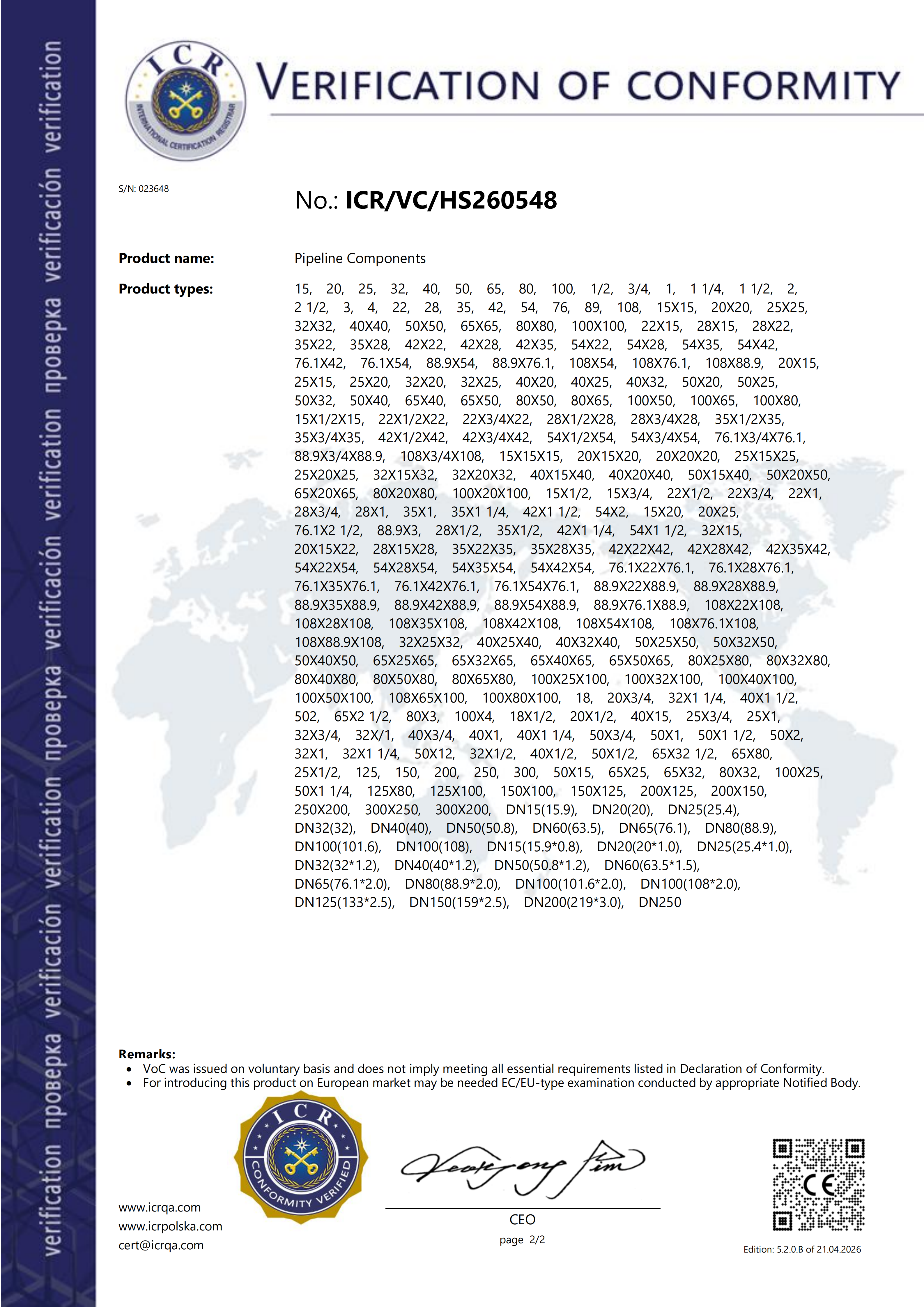
For EU-bound projects, the CE-PED Verification of Conformity is the document that turns a datasheet claim into an auditable fact. The certificate for the stainless-steel press-fit pipeline components is ICR/VC/HS260548, issued by ICR Polska on 13 May 2026 and valid until 12 May 2031, with reference to EN1092-1:2018. Its certified scope covers stainless-steel press-fit pipeline components across the full size range DN15-DN250.
The certificate scope (DN15-DN250) is wider than the EN Standard Series sizes described above (to φ108 / DN100), so buyers should check two things when they receive a certificate copy: that the size they are ordering falls inside the certified scope, and that the material grade and sealing material on the purchase order match the product actually certified.
Step-by-Step Breakdown: Reading a Rating Against Your Project
The sequence below is the order in which the parameters should be fixed. Working through it in this order prevents the most common error, which is selecting on pressure alone and discovering the temperature or gasket requirement later.
- Fix the medium and its temperature band. Potable water, drainage, dry compressed air, gas, or a chemically aggressive medium. Record the maximum continuous service temperature, not the design ambient.
- Apply the pressure figure that matches that band. Use 1.6 MPa for cold-water service and 1.0 MPa for hot-water service at ≤95 °C. Do not carry the cold-water figure into a hot-water circuit.
- Select the sealing ring by medium. EPDM for drinking-water and drainage systems; HNBR for gas, and for compressed air with oil content. Never cross-use these two gaskets.
- Choose the material grade for the environment. 304 for fresh water, general compressed air and general gas pipelines; 316L for coastal, seawater, weak-chemical and high-chloride conditions.
- Match the press profile across fittings, tube and jaws. All components in one system must be M-profile or all V-profile. Do not mix Euro-standard M-profile fittings with Chinese-standard V-profile tubes or tools.
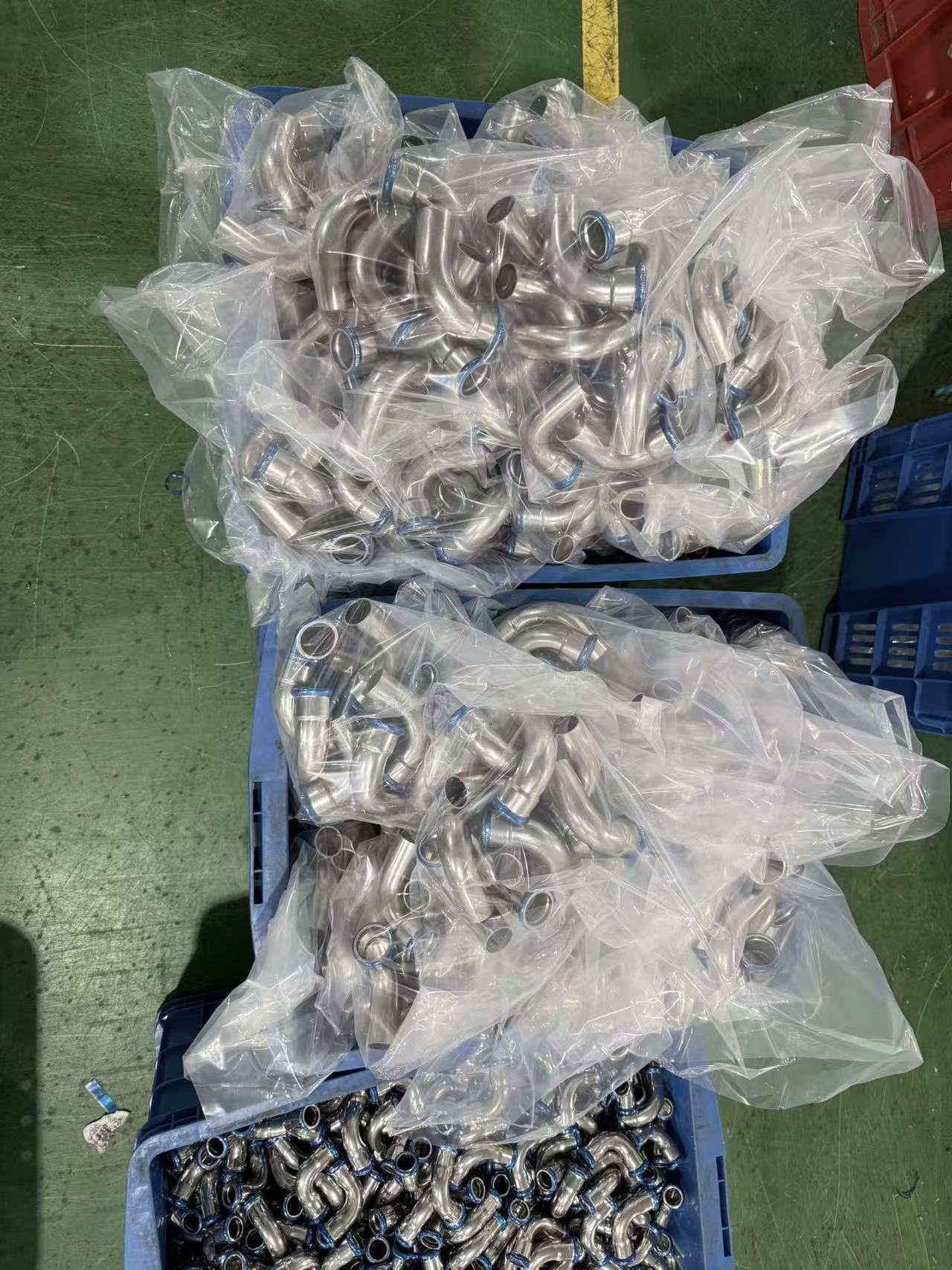
- Verify the documents and the quality gate behind the declaration. Ask for the CE-PED certificate copy, and confirm the production control actually applied: 100% visual inspection and pressure testing on fittings before dispatch.
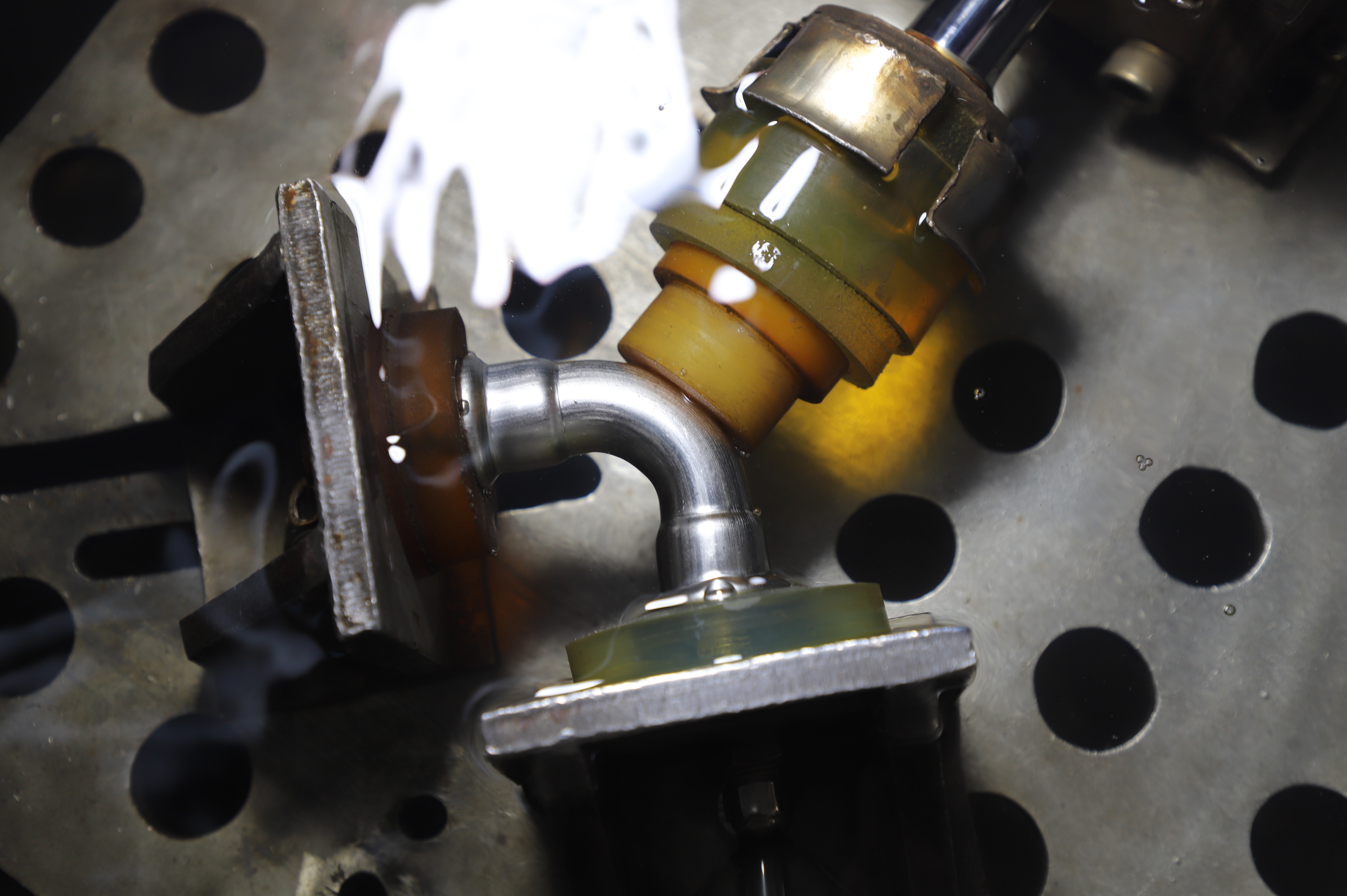
- Install to the documented procedure and pressure-test. Cut the pipe squarely and deburr inside and outside; mark the insertion depth; insert the pipe fully to the mark; place the correct jaws on the press groove; press until the jaws close completely; then pressure-test the system for leakage.
Use Cases: Where the Ratings Decide the Selection
Urban residential buildings
Domestic hot and cold water circuits switch between the two pressure figures within the same building. A riser carrying cold water at 1.6 MPa and a hot-water circuit at 1.0 MPa (≤95 °C) can be specified from one product family, provided the sealing material is correct for potable water - which is why food-grade silicone (FDA certified) or EPDM is the documented choice for these systems.
Gas supply systems
Gas service is a medium-driven selection rather than a pressure-driven one. The gasket must be HNBR, because a water-service EPDM gasket in a gas line ages rapidly and creates a gas-leakage risk. Grade selection follows the environment: 304 is preferred for general gas pipelines, with a 316L upgrade suggested for seaside gas projects.
Public constructions
Hospitals, hotels, schools and comparable buildings combine potable water, drainage and sometimes compressed air in the same structure, with high occupancy and low tolerance for maintenance shutdowns. The relevant parameters are the medium-matched gasket, the corrosion grade and a documented pressure test, since the alternative - welding - is slower and introduces heat-affected zones into the pipework.
Direct-drinking water systems
Direct-drinking water systems impose a hygienic requirement as well as a pressure requirement, which is why the FDA-certified food-grade silicone option matters. Pressure and temperature remain at the cold-water end of the envelope: 1.6 MPa, within the -20 °C to 95 °C range of the ordinary model.
A documented reference for potable-water plumbing illustrates the pattern: 12,000 pcs supplied to plumbing distributors and construction contractors across Germany, France, Spain, Italy, the United Kingdom, Russia, Belarus, Australia, Indonesia, Thailand and Taiwan, with a stated 15+ year duration and reported leak-free, corrosion-resistant operation. The highlighted advantages in that record are fast installation without welding and a service life matched to the building.
Comparison Table: Ratings and Selection Parameters
The tables below set the documented parameters side by side. They contain only the figures stated in the product data; where a value is not stated for a configuration, that is indicated rather than estimated.
| Parameter | Ordinary model | High-temperature resistant model |
|---|---|---|
| Main material | 304 stainless steel (06Cr19Ni10) or 316L stainless steel (022Cr17Ni12Mo2) | 304 stainless steel (06Cr19Ni10) or 316L stainless steel (022Cr17Ni12Mo2) |
| Suitable pipe outer diameter | DN15 (φ16) - DN100 (φ108) | DN15 (φ16) - DN100 (φ108) |
| Working pressure, cold water | 1.6 MPa | 1.6 MPa |
| Working pressure, hot water (≤95 °C) | 1.0 MPa | 1.0 MPa for service up to 95 °C; the pressure figure above 95 °C is not stated in the product data and should be confirmed for the specific service temperature |
| Working temperature | -20 °C to 95 °C | -40 °C to 120 °C |
| Sealing material | Food-grade silicone (FDA certified) or EPDM (temperature and oil resistant) | Food-grade silicone (FDA certified) or EPDM (temperature and oil resistant) |
| Sealing ring requirement | Ring as supplied with the ordinary model | Requires replacement of the sealing ring |
| Fitting types in the family | Press-fit elbow, press-fit coupling, press-fit tee | Press-fit elbow, press-fit coupling, press-fit tee |
| Service medium | Recommended material | Sealing ring | Basis |
|---|---|---|---|
| Potable water and drainage | 304 or 316L | EPDM | EPDM performs well in water medium |
| Direct-drinking water | 304 or 316L | Food-grade silicone (FDA certified) | Documented sealing option for hygienic water service |
| Dry compressed air | 304 | EPDM | 304 is suitable for normal tap water and dry compressed air |
| Gas and oil-gas medium | 304; 316L upgrade for coastal gas projects | HNBR | Water-service EPDM ages rapidly in gas service and causes leakage risk |
| Seawater, coastal, weak acid-alkali, chemical | 316L | Matched to medium | 304 is prone to pitting corrosion in high-chloride conditions |
| Item | M Profile (Euro-standard) | V Profile (Chinese standard) |
|---|---|---|
| Press-groove dimension | Euro-standard M-profile groove | Chinese-standard V-profile groove |
| Sealing-ring groove | Matched to M-profile fittings | Does not match the M-profile groove |
| Pressing tools | M-type pressing jaws | V-type pressing jaws |
| Typical application | European-standard projects | Domestic and most Southeast Asian projects |
| Mixing two profiles in one system | Not recommended | Not recommended |
FAQ
Are these stainless steel press fittings CE certified for European projects?
Yes. The CE-PED Verification of Conformity for the stainless-steel press-fit pipeline components is certificate ICR/VC/HS260548, issued by ICR Polska on 13 May 2026 and valid until 12 May 2031, with reference to EN1092-1:2018. The certified scope covers stainless-steel press-fit pipeline components across the full size range DN15-DN250. Wenzhou Zhengxin Pipe Industry Co., Ltd. also operates an ISO 9001:2000 quality management system and has introduced the QS9000 production management system. Buyers should still confirm that the size, material grade and sealing material on the purchase order fall inside the certified scope and match the certificate copy supplied with the shipment.
What working pressure and temperature ranges are documented for these press fittings?
Two rating pairs are documented. Working pressure is 1.6 MPa for cold water and 1.0 MPa for hot water at ≤95 °C. Working temperature is -20 °C to 95 °C for the ordinary model and -40 °C to 120 °C for the high-temperature resistant model, which requires replacement of the sealing ring. The same envelope applies to the European standard press fittings (EN Standard Series) and to the GB double-press fittings, which are available in 304 stainless steel (06Cr19Ni10) or 316L stainless steel (022Cr17Ni12Mo2) with pipe outer diameters from DN15 (φ16) to DN100 (φ108).
Can you manufacture OEM stainless steel press fittings for HVAC systems?
OEM and ODM production are both available, covering customization of logo, size, material and packaging. Monthly capacity is 83,000 pcs of fittings and 83 tons of pipe, and the manufacturer exports to the EU, Southeast Asia and the Middle East. For an HVAC OEM specification, four parameters should be fixed in writing: the press profile (M or V), the material grade (304 or 316L), the sealing material matched to the medium, and the pressure and temperature envelope of the circuit - cold water at 1.6 MPa, or hot water at 1.0 MPa up to 95 °C.
What are the MOQ, lead time and payment terms?
Minimum order quantity is documented from 10 pcs for standard procurement, while customized OEM/ODM production runs are quoted from 100 pcs. Lead time is 25-40 days depending on specification and order quantity. Payment terms are 30% deposit with 70% balance before shipment, and delivery can be arranged on EXW, FOB or CIF terms. Every order passes 100% visual inspection and pressure testing before dispatch, and pre-shipment inspection with factory visual and dimension checking can be arranged for the buyer.
How can a buyer validate these ratings against a specific project before ordering?
Start with the service condition, then request the matching documents. For a hot-water circuit, state the maximum service temperature so that the ordinary model (-20 °C to 95 °C) or the high-temperature resistant model (-40 °C to 120 °C, with its matching sealing ring) can be confirmed; for a gas circuit, specify an HNBR gasket rather than a water-service EPDM gasket; for a coastal project, specify 316L rather than 304. Then request the parameter sheet, the CE-PED certificate copy and a sample for fitting and pressing trials. Remote technical support and installation guidance are provided after delivery. To begin an evaluation, send your project specification, size list and service medium to cindy@zxpipeindustry.com or WhatsApp/WeChat +86 18966285772.
Conclusion
Pressure and temperature ratings are one specification, not two. On Wenzhou Zhengxin press fittings the documented envelope is 1.6 MPa for cold water, 1.0 MPa for hot water at ≤95 °C, -20 °C to 95 °C for the ordinary model, and -40 °C to 120 °C for the high-temperature resistant model with its matched sealing ring, across sizes DN15 (φ16) to DN100 (φ108) in 304 or 316L stainless steel.
Four checks decide whether a quotation actually fits a project: the temperature band that applies to the pressure figure, the sealing material matched to the medium, the material grade matched to the environment, and the press profile matched across fittings, tube and jaws. A fifth check protects the other four: the CE-PED certificate copy, valid until 12 May 2031 under certificate ICR/VC/HS260548, and the 100% visual inspection and pressure testing applied to every fitting before dispatch.
Next step: Send your project specification - service medium, maximum service temperature, size list and press profile - and we will return a parameter match and quotation within the documented 25-40 day lead time.
Download the full product catalog: Product Catalog (PDF)
WENZHOU ZHENGXIN PIPE FITTINGS CO., LTD | www.zxpipeindustry.com | Email: cindy@zxpipeindustry.com | Tel / WhatsApp / WeChat: +86 18966285772
Have Questions or Need More Details?
Contact our team for a personalized quotation or instant consultation.
Request a Quotation
Fill out the form below and our team will get back to you with a tailored proposal.
WhatsApp Direct Chat
Prefer to chat in real-time? Message us on WhatsApp for instant assistance & quick answers.
- Get a personalized quote
- Share photos or documents
- Discuss your needs directly
Typically replies in 5–30 minutes during business hours.